Caffeinated Chronicles: Part 7- Unveiling Adolescence: A Crucial Moment That Altered My Path Forever

Imagine a group of teenage boys sitting around a table at lunchtime. What are they discussing? What are they doing? Why are they laughing?

I’ll tell you what’s going on. One of the boys is me. I’m 15 years old. I’m sitting with my two closest friends, Thomas and Eric*. Joining us are a few other boys, younger than we are. Our school is so small that there are only a few tables, and kids from 7th through 12th grade eat together.

We’re discussing the girls, because of course we are. One of the boys very obviously has a crush on Michaela*. We’re spending some time teasing him and gossiping, as teenagers often do during lunch.

“Michaela’s hot!” I say.

“Her family has an SUV,” Thomas chimes in, I guess pointing out how much money they have.

“Guess what did we in the backseat of her car!” I exclaim, making an obviously off-color joke.

Lunch ends, and we all go back to class. I don’t think anymore about what we’ve been discussing at lunch. It’s no more or less ridiculous than any other conversations we teen boys have.

Later in the day, I’m sitting in class. I don’t remember which one. The pastor’s wife, who is also the English teacher, comes in and calls me and Eric out of class. I’m not sure what she needs us for, but I’m sure it can’t be anything too bad.

Eric and I are led into the main church auditorium. We’re told to sit and wait. A short while later Manfred* comes out of the principal’s office, which is in the hall just outside the auditorium. He was one of the younger boys sitting with us at lunch, the one who has a crush on Michaela. As he passes me, he grins. I’m incredibly confused.

I’m called into the principal’s office. And this is the last moment I feel fully secure and at home in the Fundamentalist Baptist Church.

“Do you know why I called you in here today?” The principal asks. He’s a middle aged man, tall and thin. He has a mustache and glasses.

“No,” I reply honestly.

“What did you talk about at lunch today?” He asks me.

“Uh… I don’t really remember,” I say.

“Well, Manfred was just in here, and he told me a few things,” he says. “He told me that you talked about Michaela.”

“Yeah, I guess we did,” I reply. I see now where this is going.

“He told me you said,” he checks his Post-It notes, where he’s been writing things down, “‘Michaela’s hot’ and, ‘Guess what we did in the backseat of the car.”

“Yeah, I guess I did,” I reply, unsure of exactly what he wants me to say. This is a normal feeling for me. I have a fear of being punished and shamed.

And then the lecturing begins. I knew it was coming.

“Joseph, do you watch pornography?” He asks me.

“No, sir,” I respond.

“Because if I could take a gun and aim it at every young man in this school, you’re not the one I would have pulled the trigger on for having impure thoughts,” he says, bafflingly.

By the way, I’m not making any of this up.

He spends at least another half an hour lecturing me about how I needed to repent of my sin and ask God for forgiveness. He says that he will have to talk to my parents and the girl’s parents as well. Apparently Manfred has been telling everyone in his class about our conversation, and so now everyone knows.

After the lecture is over, he sends me out of the room, back to class. In class I can’t focus. I am suffering from anxiety and know that what I’ve experienced is just the beginning. Some time later I am once again summoned to the principal’s office.

I’m surprised, as I enter, to see almost everyone from Manfred’s class in the room. And there, in the chair, is Michaela. She’s sobbing with her head in her hands.

“Joseph,” the principal addresses me, “the comments you made at lunch have affected everyone in this room. You will need to ask the forgiveness of all of them.”

He begins to go around the room of 10 or so people. He asks each of them the same question:

“Do you forgive Joseph?”

They invariably respond with, “Yes.”

And then he reaches Michaela. She’s still sitting with her head in her hands. He asks her the question.

Through her fingers she sobs out a “yes.”

I can’t remain unmoved by the young girl’s crying and obvious distress. She has been embarrassed publicly for something that I said.

“I’m sorry, Michaela,” I tell her.

The principal dismisses everyone but me from the office.

“After school I’m going to be speaking with your parents,” he tells me. “You’re probably going to be suspended.”

I’m flabbergasted. I’ve never even received a detention in my whole time at this school.

“Yes, sir,” I say, and exit the office.

And the talk with my parents happens. My dad is a teacher at the school, so my behavior also reflects badly on him. But when we get home, my parents are surprisingly understanding.

I explain the story to them. I explain that I thought it wasn’t a big deal. I’m not proud of what I said, but I’m more embarrassed than ashamed. I make up a stupid excuse that I was talking about playing video games in the back seat of the girl’s car.

My parents confront the principal the next day. I am called back into the office.

“Your parents tell me you said you were talking about video games,” he tells me.

Of course it’s a lie.

“No, I wasn’t,” I tell him, honestly.

“You are going to receive an in-school suspension,” he informs me.

Going to bed is a relief to me every night during this time. When I sleep I can forget the trouble I’ve found myself in. When I wake up, I am sick with anxiety, not wanting to face the principal or my peers, because everyone knows what’s going on. Again, it’s a small school.

Later that week we have soccer practice. I attend, and run my laps as normal. We do a drill where we have to try to get the ball past our goalkeeper, Thomas. The coach, who is also the youth pastor, keeps score. The winners don’t have to run sprints at the end of practice.

I lose the ball at one point.

“Joseph loses a point,” the coach says. Disappointed, I continue playing.

“Never mind, Joseph doesn’t lose a point,” he corrects himself.

I find this strange. Usually he’s tough on us during practice. Why is he being so nice?

I learn the answer when I get home. My parents sit me down.

“You’re going to be taken off the soccer team,” they inform me.

I’m devastated. I love playing soccer. I love being on the team. My best friends play too.

I know I have to return my jersey, so the next day I wait until the coach is out of his office. I sneak in through the unlocked door and set the jersey on a chair. I’m too ashamed to face him.

And so began the end of my life among the fundamentalist Baptists. The next chapter of my life would begin to completely change my way of thinking. I would remain in Baptist churches and go to a Baptist college for 10 more years, but the rift that began with this experience would continue widening, little by little until the inevitable separation.

This moment in time was incredibly stressful and difficult in my teenage mind. The after-effects resonated throughout the school and church. But I look back on this time as the spark that set off a deep change in my heart and mind, the effects of which would take years to be fully realized. And for that, I am thankful.

What about you? Can you look back on an instance in your life that set off a series of events that changed who you are? If so, let me know in the comments or via email. I would love to engage with you. Also, sign up to my blog using the link below to continue following my journey of deconstruction and rebuilding.

Caffeinated Chronicles: Part 6 – Breaking Boundaries: Adventures in Faith and Friendship

To speak frankly, the Baptist church broke me. I spoke in my last post about how excited I was to begin a new adventure in the North Country of Minnesota. And there was much that was positive about my time there, but it’s also where I began to develop my own set of thoughts and beliefs. It’s where I experienced adolescence, which is difficult enough on its own, but to have spiritual abuse added to the mix made it something entirely worse.

I can’t cover every detail about my life in my first few years in Minnesota, because it would end up being novel-length. So let me address some of the high(and low)lights.

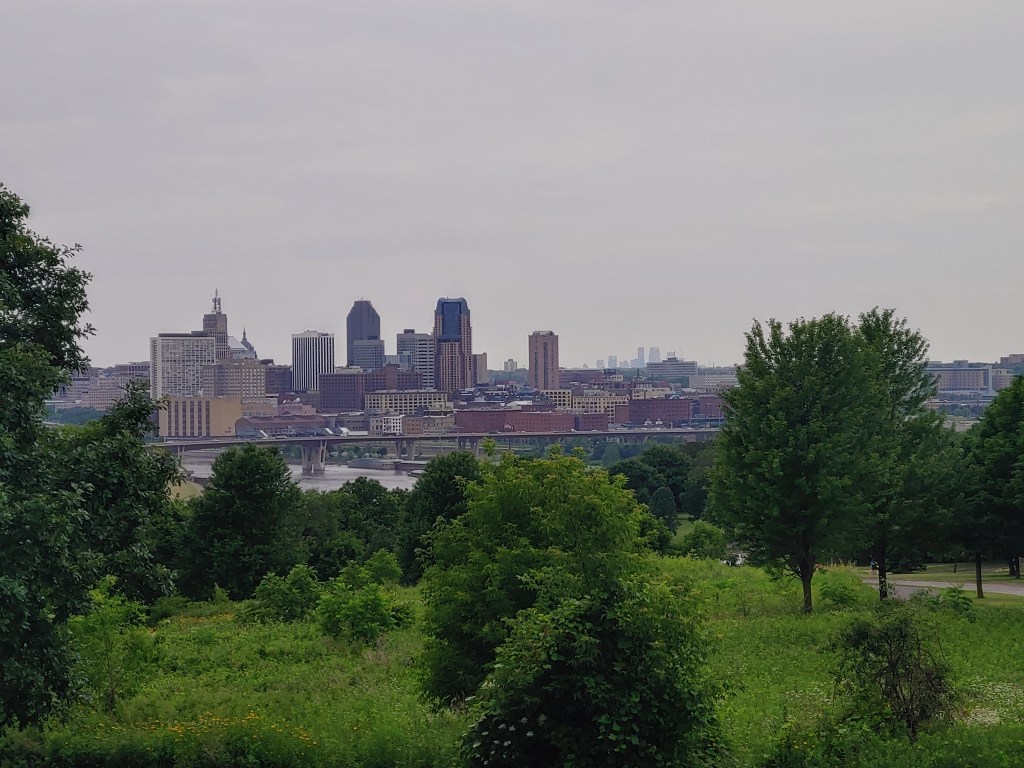
The skyline of Saint Paul, Minnesota

I pointed out in my last post that going to school was completely new to me. I’d never been to public school, and so I didn’t know what to expect. I spoke of my social awkwardness, my tendency toward trying to be funny and a class clown. It was my way of coping with new experiences.

I told you, I spent at least 6 days every week at the church building that also served as a school. My first year there, we had a principal from a southern state. You could tell by the way he talked. Sometimes when he was trying to give a lecture or be hard on us kids, it would sound so funny that we would laugh or giggle. This would upset him even more. I never crossed him too much, since I was always deferential and tried to follow the rules when I was being watched. The same can’t be said of my friend.

I knew him from the first weeks of life in Minnesota. When I first met him, I noticed he was tall, had a thick Minnesotan accent, and had died his hair an unnatural shade of red. He was a bit older than me, around my brother’s age. His name was Thomas*.

At first I don’t think he liked me too much. He was my brother’s age, about two years older than I was. I was young and annoying. I dressed funny and played foolish jokes on people. Thomas was cool. He had a job, and he shopped at designer clothing shops so often that the people at the local Banana Republic knew him by name. He was a bit embarrassed by that.

That all changed in the winter of 2004 when we went on a mission trip to Uruguay with our youth group. For some reason, our youth pastor teamed us up, and so we sat next to each other on the plane and spent much of our free time together. It turned out we got along much better than either of us had realized.

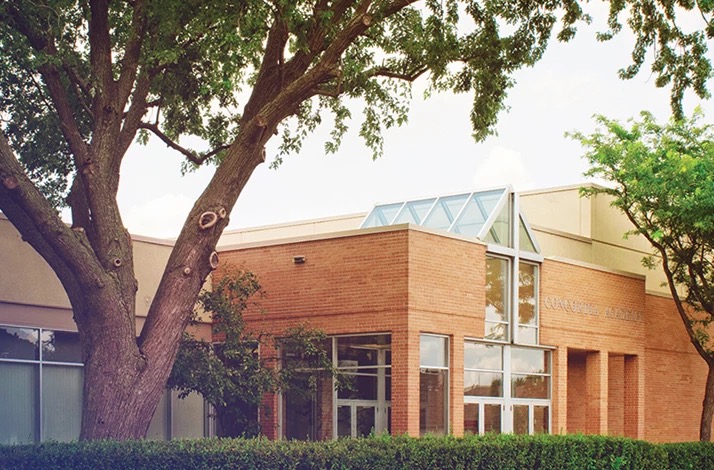
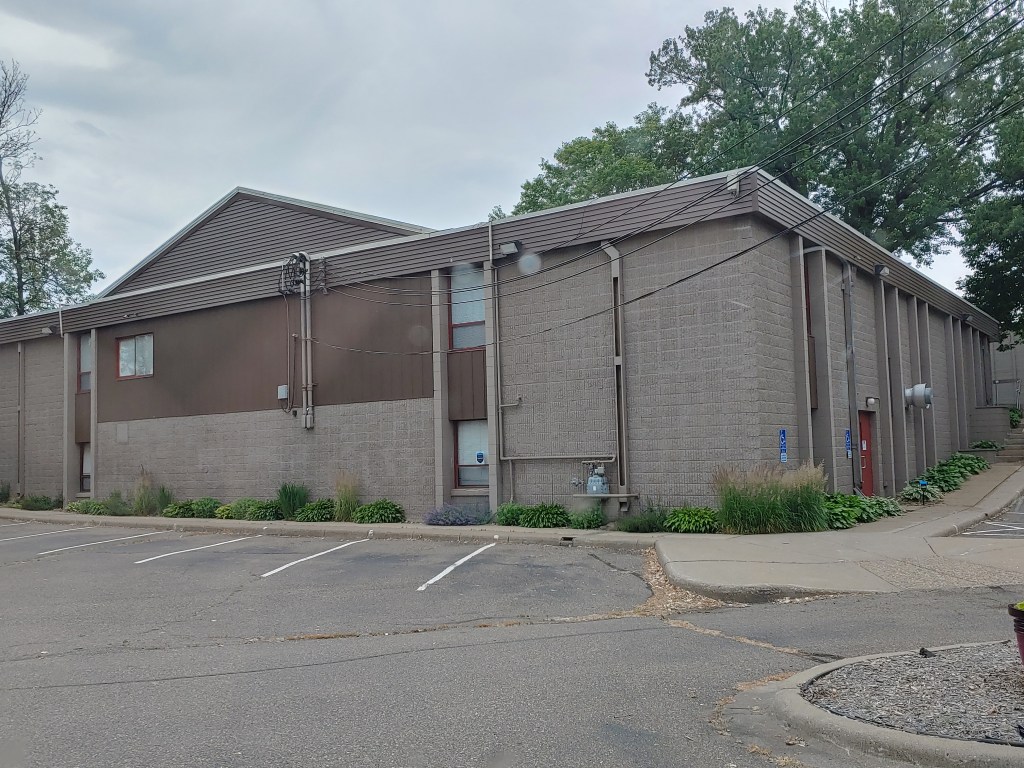
The outside of the church and school I attended for my first three years in Minnesota, 2002-2005

I think our youth pastor regretted his decision to pair us up rather quickly. I remember being called into his office to talk at one point. I was told that I was a good kid, but that I needed to stop spending so much time with Thomas. I said, “yes, sir,” but I didn’t listen.

I’ll delve into some of the more ridiculous situations we got ourselves into in a later post, but Thomas has become a lifelong friend, someone I still talk to rather often and spend time with whenever I’m in town.

School itself was fine. I’ve always been the type of person who didn’t have to try too hard in school to get good grades. So I usually did my homework, but I wouldn’t study for tests or go above and beyond in any way. I wonder how much more I could have achieved if I’d taken my schooling more seriously…

We used mostly Bob Jones curriculum, the same as what I’d used when I was homeschooling. As a result, I largely knew what to expect. It was “history” and “science” with a fundamentalist Christian bent. That means we learned science from an exclusively young earth creationist perspective, with many proof-textings from the Bible. Our history, especially the American history, had a conservative bias, for example heavily focusing on states’ rights as the primary driver behind the Civil War.

I didn’t think critically about it, and I hardly even knew there were any other perspectives. I wasn’t taught to think critically, and I was expected to accept all the teachings as gospel truth, especially when it came to things like the Bible. I was taught one way to interpret the Bible: literally. Any apparent contradictions or errors were either explained in such a way that the answers put the onus on the individual for not understanding correctly or were explained away in such a way that they weren’t really contradictions or errors at all.

I thought this was the only approach to the Bible and to science and history. This would lead to a sort of crisis of faith for me during college, when I realized that there were other ways of reading and interpreting the Bible, and when I started to read about scientific topics, realizing that many of the things I’d been taught were just plain wrong. But that, too, is a topic for another post.

The rules were very much black and white. Dress code was heavily tilted to place more of the burden on the girls, as is quite common in this type of church. Girls had to wear skirts, couldn’t have shirts cut too low, had to have their hair in a certain way. I remember that they would have dress checks before we had our formal banquets in the spring. They had to make sure that us boys were protected.

But the dress code didn’t only burden the girls. For boys, we were required to wear collared shirts and to have them tucked into our pants. We had to wear belts if our pants had belt loops. We also had to be clean-shaven. This wasn’t a problem for me at all during my teenage years. I only had to shave once a week, if I was lucky.

Thomas wasn’t so lucky though. Sometimes the principal or secretary would come into a class room, and the boys would have to stand. They would walk up and down the rows of the boys and check to make sure we were wearing belts, and then they would lean in close to our faces to make sure we had shaved. If you had failed to shave that day, you would not only be written up, but you would be sent to the bathroom to shave with a pink women’s razor.

Yeah, shame was a big part of the experience.

One day one of these checks took place and Thomas was told he hadn’t shaved, and was sent to the bathroom to shave. The problem was that he had, in fact, shaved that morning, but his hair grew in quickly and so he had some stubble on his face. There was no use in arguing however, though he often tried; rules were rules, and authority was to be respected and unquestioningly obeyed.

Thomas was often getting in trouble for this kind of thing. He was never a strict rule follower. He was the type who wanted to know why the rules existed in the first place. He was also different in the fact that his family were Democrats. We looked askance at Democrats or anything having to do with them. All good Christians are Republicans, so they were not good Christians.

The only reason he even went to that school was that his mom was a teacher there. She was a wonderful, kind, generous person who was very much beloved by her students and others in the school. Perhaps his parents were a bit too permissive, but they obviously loved him, and I really enjoyed getting to know his whole family.

And I, the good kid, would allow myself to be drawn into his antics, which is why I was told not to hang out with him. Most of the things we did were innocent enough, at least at first. He would hold my hand and we would sing songs together from the stage in the sanctuary. “It looks like you’re gay,” we were reprimanded. We would play wrestle and rough house in class. We would run together at soccer practice and gossip and complain about the rules.

He was a classic bad influence.

But he began to open my mind in some ways that I had never thought of before. I’d never spent much time with a real Democrat. It turned out they weren’t as bad as I’d been led to believe. He’d question some of the policies at the school, and some of the political messages we received. Once our principal showed up for a patriotic day dressed in full Civil War chaplain attire, revolver and all. Thomas wasn’t crazy about that.

They had a “government” class, which mostly consisted of long, meandering lectures from the principal. The message boiled down to “America good” and “other countries bad.” Or more specifically, “capitalism good” and “anything that isn’t explicitly capitalistic is socialism or communism.” Thomas really liked to shake things up in that class, poking holes in the teacher’s arguments and sometimes purposely playing devil’s advocate in order to feel heard and annoy him.

Being younger than he was, I looked up to him. I wanted to impress him. I didn’t want him to think I was a sheltered baby. This got us into a lot of trouble later on, but it started innocently enough. If it hadn’t been for him, I don’t know how I would have turned out. He is partially responsible for starting me on a path that I never saw coming, and, in hindsight, ended up having a positive outcome.

And so, I continued in this school until my sophomore year of high school, 10th grade. Why did I leave after 10th grade, you ask? Well that’s a story for the next blog post. It was an event that sparked my desire for something different and forced me into uncomfortable relationships with people of other faith backgrounds. It fundamentally altered the course of my life. It was traumatic at the time, but looking back I am thankful. If I hadn’t been suspended in my 10th grade year, my life would have been completely different.

But that’s a story for next time.

Life is crazy, my friends. Everyone’s journey is a little bit different. What about you? What experiences did you have in school growing up that have stuck with you and shaped you to become the person you are today? Feel free to leave me a comment below or send me an email. I’d love to hear more about your life.

Until next time, I wish you peace and a spirit of grace. Make time for kindness.

*Not his real name

Caffeinated Chronicles: Part 5 – Frosty Beginnings: Unraveling the Northern Odyssey

I know it’s been a bit since my last post, but you know how life is. From this point on is when we really start getting into the weeds of my life and the development of my faith. Yes, this is all focused on me and my experience. I can only tell my story and where it’s led. I know many others will have had similar but different experiences. I hope you find consolation in the fact that you are not alone. If my story resonates with you, I hope you’ll let me know, either in the comments or via email. I would love to hear about your faith journey too.

I left off with my family still in South Carolina. Our time there was the longest that we’ve stayed in one place in my whole life. It was very much home to me, and I still feel a certain nostalgia for it, despite having left more than two decades ago.

My dad was a teacher. He was always a teacher. He only ever wanted to be a teacher. He worked at Toys R Us the seven years we lived in South Carolina, but he always wanted to go back to teaching. He had been a teacher before I was born but had left to pastor the church in Kentucky that I spoke about previously. Having graduated from a Conservative Christian college, he never received a state license to teach. The college couldn’t provide one for him since they weren’t accredited at the time.

And so, in order to teach he need needed to find jobs in private schools that didn’t require licensure. Having given up his dream of finishing a master’s program at Bob Jones University, he began seeking new opportunities to teach. He reached out to school all over the country, which was a bit harder to do in the early days of the internet. He sent his resume around until he was finally contacted by a school in Saint Paul, Minnesota. 

My parents dropped me off at my uncle and aunt’s house, which wasn’t far from where we lived in South Carolina, and flew to Minnesota to interview and survey the church and school. Of course, I forgot to mention, it was a fundamentalist Christian school. In order to be a teacher there, he was required to attend the church with his whole family. 

It wasn’t much later that my parents declared their intention to uproot their family and move to the frozen north. And so, we rented a moving truck, which we spent all day loading (my dad was terrible at this), and we set off for new adventures in a new place. I remember the exact date, in fact. It was August 5, 2002. I was 13 years old, and it seemed like an adventure. I’d never been that far north before, and I was excited to experience more snow than I’d ever seen before. Boy, was I naïve.

We arrived at our new home in Cottage Grove, Minnesota a few days later, having stopped to visit my grandparents and a few other places on the way. When we arrived, a host of people from our new church and school came to help us unload. I met my new math teacher, the pastor’s son, and others. It was a hot day in Minnesota, I was told, but to me it seemed like nothing.

It was about a month later that I began my first year attending school. Since it was a small Christian school, my dad was a teacher for many different classes. He was my eighth-grade homeroom teacher, my math teacher, my English teacher, my history teacher, and a teacher for some classes for the high school students. 

Yeah, there was no way to get away from him.

I was brimming with excitement about finally going to school like all the other kids. It was definitely different from my homeschooling experience. For one, there were other kids around who weren’t my siblings. I got to know most of these kids really well because they also went to the church. The school was in the same building as the church, and so I was at that building at least 6 days every week, sometimes 7 if there was a Saturday youth activity. 

It was around this time that I also started realizing that I was different than most other kids. I was somewhat maladjusted because of my years homeschooling. I wasn’t sure how to interact with other people my own age, so I learned to be funny. Or at least, I tried. It was my way to get the feedback I needed. If I could make people laugh then I didn’t have to wonder or worry about what they were feeling about me.

This habit of trying to be funny has stayed with me ever since. It keeps me from having to share my true feelings, and it gives me an out when I’m not sure what people expect from me. I’m sure some people are annoyed by it, but I’ve been at it too long to know any other way of interacting with others.

And I was successful, for the most part. I became something of a class clown, though I was always obedient, and tried hard not to hurt anyone with my jokes, though I’m sure I did, and I still do sometimes. If I’ve ever hurt you, I’m sorry.

And so, I spent three years attending this small Baptist school. It’s where I first discovered the opposite sex. It’s where I tried my hardest to win the approval of those in authority and my peers.

I didn’t have words for it at the time, but it’s also where I began to come to terms with what I began to call my “inner darkness,” a deep melancholy feeling that wouldn’t let me enjoy even positive experiences to their fullest extent, and learned to second-guess and over-analyze every social interaction I had until I was exhausted. I learned that what I was dealing with was a sin problem, and that I wasn’t having enough faith or trust in the power of God to take away these feelings.

But enough about that for now. There are many more things I need to say about my time at this school and church, some positive, but many very dark as well. I’ll pick it up next time, discussing my experience at school and church in Saint Paul, Minnesota. I had some wild adventures, and I made a dear friend, someone who’s stuck by my side until this day.

Follow along for more adventures and studies of a theology that always left me feeling inadequate. Sign up using the link below so you don’t miss the rest of this wild ride.

Brewing Faith Part 2: A Pretentious Look at Being Pretentious

Yeah, I’m gonna write about coffee again. What? Did you think that I titled my blog “Coffee and Theology” for nothing? I’ve spent some time writing posts about my background and my theological misgivings. But I don’t want to lose focus of the second great love of my life after Jesus (third, if you count my wife. Sorry, Rachel): coffee.

My first job was at Caribou Coffee at the Rosedale Center in Roseville, Minnesota. It was a kiosk in the middle of the shopping mall, and it was perhaps not run as well as some other stores. However, it was here that I first learned about the differences between dark and light roast coffees, what French roast means, and how to make espresso beverages.

For those of you that don’t know, Starbucks rules the world in terms of chain coffee shops.

Except in Minnesota.

Along with the many oddities of my home state, such as calling a casserole a hot dish, playing duck, duck, gray duck instead of duck, duck, goose, and often exclaiming “uffdah!” when we run into someone at the store, we have a uniquely Minnesotan coffee chain.

Caribou rules Minnesota. Starbucks exists, but Caribou is usually preferred by the locals.

The actual Caribou I worked at! Source: https://www.cbsnews.com/minnesota/news/why-are-so-many-malls-in-minnesota-called-blank-dale/

And so, as I worked at a chain coffee shop, where the lines could sometimes be 10-15 minutes long, the coffee we made didn’t exactly live up to the small batch roasted, artisanal coffee that I have come to be snobbish about in my adult years. But I enjoyed the job and learning about coffee.

I learned very quickly that I preferred light roast coffee. Though I would pretend that I loved the deep dark, oily roasts, such as French roast, in order to impress the girls. At first I also loved the sugary, whip-cream topped “lattes” that we sold. When many people say they love coffee, these are the types of drinks they’re talking about. But after a time, I couldn’t handle the overly sweet drinks anymore, and I learned to love plain, black coffee.

I came to love the nutty, often fruity flavors of a good quality light roast, freshly brewed from the pot. I came to despise adding anything to my coffee that took away from its unique flavor profile and made it less than what it was.

Lord, I sounded pretentious just there.

I fell into the trap of looking down on anyone who would dare to order anything that wasn’t plain, black coffee, looking upon them with an air of indignation that would make even the most pretentious movie critics seem humble by comparison.

In fact, I complained so much about it to my girlfriend in college (my wife now) that she would order plain black coffee when we went to a cafe to study. She obviously hated it, but she would try to drink it to impress me. Then she wouldn’t finish it and throw away the remainder. That would annoy me even more.

I’m sorry, Rachel. I don’t care if you put milk in your coffee anymore.

Anyway, back to my coffee journey.

In a way my journey from not caring in the least about the quality of my coffee to the caring overly much to the point of becoming pretentious to only caring about making good coffee for myself and giving others the freedom to love coffee the way that they like closely mirrors my faith journey. In fact, it took kind of a similar path at around the same time.

As I mentioned in my other blog series, I grew up in an incredibly legalistic, overly judgmental faith tradition. At first, it scared me. But later, in adolescence, I wanted to please those around me, so I adopted this set of beliefs and wanted to force others around me into this same tradition.

It was unhealthy, both to me and to those around me.

But later, as my mind opened, and I learned to hold onto the things that are most important in my faith and let everything else go, I began to appreciate other expressions of Christianity, and to acknowledge them as equally valid ways to love God. I began to want to talk with people about their differing beliefs, rather than judging them for those beliefs.

And with my love of coffee, I feel the same. Enjoy your coffee however you want. If you aren’t harming anyone, you can enjoy your caffeine fix in whatever way is most palatable to you. You have my permission.

I know, you really hoped I would give you my permission.

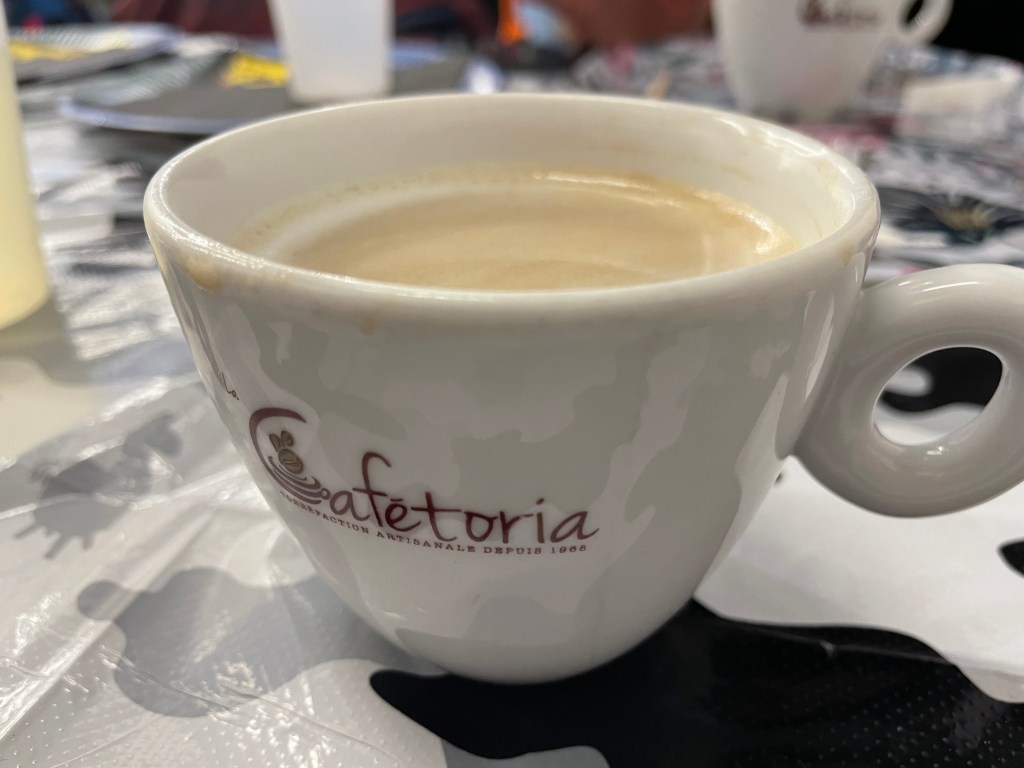
Coffee from our favorite cafe in Calais

As we experience this journey together, it’s important to remember that there isn’t only one way to love God and love our neighbor as ourselves. These are the greatest commandments handed down to us by Jesus.

As long as your goal is to love God and love your neighbor, then you can count on my support, even if we disagree on other issues of theology.

Just know: I will continue taking my coffee black.

What about you? How do you prefer your coffee? Have your tastes changed over the years? More importantly, how do you interact with people who have different perspectives from yours? Let me know in the comments. Follow my journey into the worlds of theology and coffee. Let’s get caffeinated together!

Caffeinated Chronicles: Part 4 – From Hymns to Heartache: Unveiling the Facade of Familial Bliss

Well I guess it’s that time.

Time for me to begin delving into my faith formation. I’ve touched on it a bit so far, but it goes much deeper than you may perhaps realize. I talked in my previous post about my experience going to church at least three times every week. In that post, I made it sound completely positive.

And in a way, it was.

After all, I had my family, friends, and social gatherings all tied to one place. I didn’t go to school because I was homeschooled, so I didn’t have much opportunity to interact with other kids outside of my neighborhood apart from church. So in a real way, church was my community, my whole life.

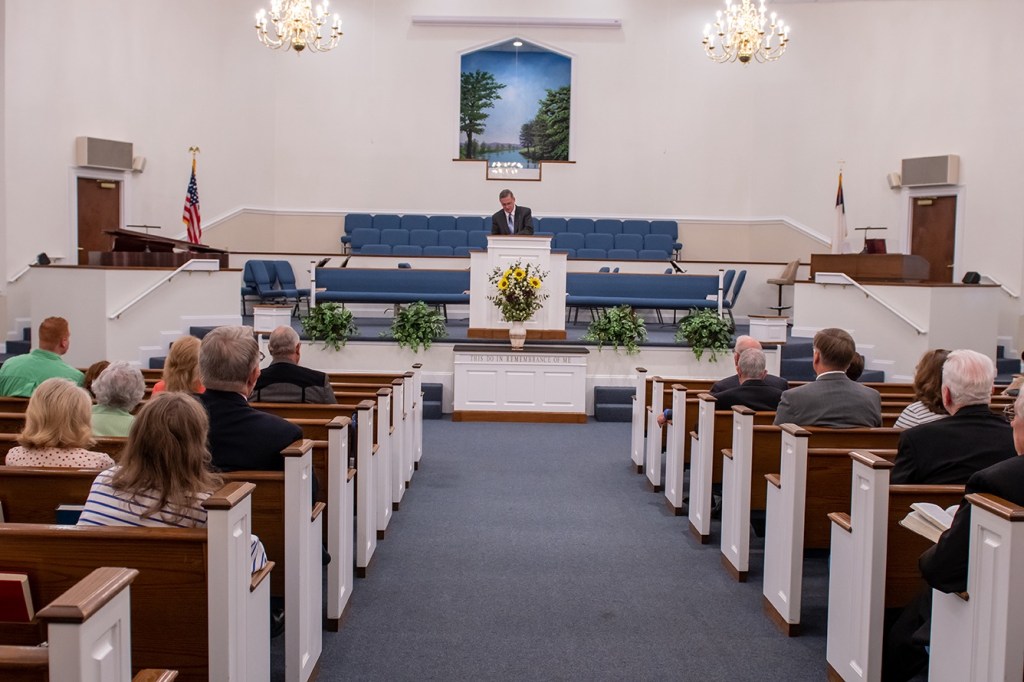
An actual photo of the church I went to in South Carolina. It was in a different building when I was there, but that one was torn down and a new one replaced it.

What I didn’t see as a child growing up there was how much its teachings were affecting me, how damaging some of the things that were said from the pulpit would end up being to my developing mind. I didn’t see how my mental health would suffer as a result of constant manipulation by the leaders, who stated quite plainly that they were just, “following the Bible.”

It would be impossible for me to list here everything that was said that could be damaging or cause me to doubt my salvation, so I’ll plan to only hit on a few main points. I’ll start with an anecdote. It’s a simple one, but it’s one of my favorites to tell because of how it’s equal parts funny and disturbing in hindsight. I tell it all the time when I speak in front of churches.

It was a normal Sunday evening service. I was perhaps 9 or 10 years old. As always, I was incredibly bored. My mom had started to take away any kind of drawing supplies or coloring pages she had given me when I was younger, so I was forced to pay attention to the sermon. Ugh.

This night we had a guest speaker. I don’t remember his name or where he was from. I just remember that our regular pastor wasn’t preaching that night. And while I don’t remember the main point of his sermon, something he said hit me hard. So hard, in fact, that I carry it with me to this day.

“When we get to heaven, we’re going to spend an eternity praising the Lord! We’ll sing hymns and songs; we’ll hear his greatness announced and his character discussed! All of eternity will be spent worshiping God!”

In my mind, I thought, “That sounds like the most boring, awful thing ever!”

And immediately following his pronouncement, the preacher said, “If that doesn’t sound amazing to you, you don’t know Christ as your Lord and Savior.”

And I was devistated.

“I must not know Christ as my Lord and Savior!” I thought to myself in a panic. Thankfully, I had just the remedy for this: asking Jesus to save me.

And so I did. Again. And again. And again. And again.

You see, this is just one example of a pattern. Our church would say that they didn’t believe you could lose your salvation once you’d accepted Jesus as your Lord and Savior. But they’d append it by saying that if you didn’t do this, or believe that, or act this way, you never really knew Jesus in the first place.

This, probably more than anything else, really messed with me. I must have accepted Jesus as my Lord and Savior hundreds of times, without exaggeration.

But that’s not all.

From the time I was born I was programmed. I was programmed to believe that the church had the answers, and that only this church had the answers. The pastor placed such an emphasis on “correct doctrine” that he believed anyone who disagreed or had differences from this doctrine was in danger of hellfire.

I was programmed to believe in the Bible as the inerrant Word of God. See, there aren’t any contradictions in the Bible. There aren’t any incorrect statements. Everything in the Bible is historically accurate and is meant to be taken literally and plainly.

Sorry, I don’t have any more great pictures of South Carolina, so here you go. This is the trailer park where I lived.

This of course means that any scientific or historical research that contradicts what the Bible literally says must be incorrect, because the Bible can’t be wrong. And so, the Genesis creation story (really there are multiple creation stories in Genesis, but that’s beside the point) must necessarily be an accurate representation of how the earth was created.

But “correct doctrine” didn’t just include biblical inerrancy. It also included agreeing with every standard set forth by the leaders of the church. Essentially, this meant having some form of control over every facet of our lives.

Another anecdote: I was sitting in church (as was often the case). The pastor was preaching this time. He was preaching about the evils of worldly music (any music that isn’t classical or explicitly religious).

“I used to counsel a young woman. She confessed to me once that she liked to listen to rock music. She said, ‘I don’t listen to heavy metal or anything; I just listen to light rock.’

“I’ll have you know that two weeks later that woman drove a car off a cliff and killed herself!”

And thus I learned about the dangers of rock n’ roll.

But seriously, I was led to believe that there wasn’t possibly anything else going wrong in this young woman’s life that could have led to her taking her own life. It was the rock music that killed her. In my 10 year old mind, it made sense. It hammered home the point that I should never listen to rock music.

Worship music was a big no-no too. In fact, any kind of music with a beat or with drums in it was viewed as immoral. Worship music was worst because it was considered to be “mixing truth with error.” And so the only songs we would sing in church were hymns. And the occasional patriotic song.

And I also heard things preached about making sure we obey our parents. Obedience was a big theme in the preaching at this kind of church. Our pastors obey God; our parents obey our pastors; and we obey our parents. If I didn’t obey immediately, not only would I risk being punished by my parents, but I also risked being punished by God. And if I didn’t feel bad about it, I might not be saved, so I would ask Jesus Christ to be my Lord and Savior again.

And round and round and round it went.

Anyway, these are just a few examples. There are more. Many, many more. But that would require many blog posts, and I think I’d like to address the deeper themes one at a time later on. For now, I’m just summarizing my story.

The point is, I was made to feel inadequate and completely dependent on my church. Any questioning, and toe out of line, and I was made not only to feel guilty, but also to question my own salvation. The Bible was weaponized, and God was made to seem constantly angry. He was watching and scrutinizing every little thing I did to make sure I didn’t screw up.

I didn’t have words for it then, but my mental health was seriously struggling, even when I was a child, as a result of this type of manipulation. It wasn’t until I was in my 30s that I developed the language I needed. But that’s a story for another time.

But my story is far from over. In my next post, I’ll discuss the end of my time in South Carolina and my move to Minnesota, where I spent much of my adolescence.

You’re going to want to follow along.

Caffeinated Chronicles: Part 3 – From Hymns to Hide and Seek: A Veneer of Happy Family

In my last post in the series, I shared a bit about our move to South Carolina and our lives while we were there. These were some of my formative years, where I learned about the world and what it means to be human. It wasn’t all Toys R Us and blackberry picking though. In this post I’m going to share about my church experiences in South Carolina. Buckle up.

As I was quite young when we first moved to South Carolina, I mostly remember things that were really impactful from those times: a statement made that really affected me, a particularly joyful or sorrowful experience, etc.

One of the first things we did when we moved to our new home was seek out a church. Just any church wouldn’t do, you see. We were looking for something quite specific. We needed a Baptist church.

I can hear you now, “A Baptist church? In South Carolina? That shouldn’t be too hard to come by!”

Indeed, it was easy to find Baptist churches there. Nearly every block in every town had a Baptist church. You could hardly turn around without seeing one.

But there was a problem. These were all part of the evil leftist Southern Baptist Convention (SBC).

Ok, ok, I’m exaggerating. My parents didn’t believe the SBC was an evil leftist organization. Well, not completely.

But my parents and others of their ilk didn’t believe that a Baptist church should be part of a broader convention like this. They didn’t want anyone telling them what they could and couldn’t do or say in their church. Any kind of hierarchical structure was looked at askance. And so the very institution of the SBC was an affront to their theological sensibilities.

No, they needed an independent fundamentalist Baptist church (IFB). They were looking for a church that wasn’t governed by any hierarchy, hence the “independent” part.

And don’t get me started on the “fundamentalist” part. Actually, what am I saying? That’s like the whole reason I’ve chosen to write this blog. I’m already started on it, and I have no intention of stopping.

So my parents did their research. Somehow. (I have no idea how people found places like this before the internet). And they found an appropriate church for us to try out. I won’t name the church here, because I know it still exists, and they don’t deserve to be harassed.

I remember my first Sunday at the church. I was six. During Sunday school, I was led to a side room, to the right of the platform with the pulpit (and the American flag) on it. I was given a coloring page that went along with a Bible story. I don’t remember the Bible story, but I do remember that it was the pastor’s wife who led the class. She asked how old I was and gave me some crayons. I gripped the crayons with my fist and colored all over the paper with a complete disregard for the lines. It’s how I color to this day.

And then during the main service, we would join our parents during the songs, and then we would go down a long hallway to an annex, where we would have children’s church. Children’s church was essentially a time of singing non-sensical songs such as the ones demonstrated in the videos below.

Then we would have a message from a poor college student (usually someone from Bob Jones University), often dealing with important topics for kids, such as why the Bible should be taken literally, how important it is to obey our parents, or why we should never write Xmas instead of Christmas (It’s because the liberals want to take Christ out of Christmas).

Church would then end, and we would play outside on the church grounds for a long time, while we waited for our parents to finish talking. I’d usually give my mom my Bible and run outside to play. I remember her telling me often, “I’m not your pack animal.” I didn’t understand what she meant.

Then we would go home and have a big lunch and spend time as a family before we would return to church for the evening service. Evening services were the worst ones. There was no children’s church, nothing fun to do. The kids had to sit with our parents during the whole service, even sermon time! When I was small my mom would give me coloring pages or books to keep me occupied, but when I got older she stopped, and I was expected to listen to the whole sermon. I often fell asleep.

And then there were the Wednesday night services. My parents would go to the main building and have a prayer service. How boring. We kids were lucky though. We got to go to the separate gymnasium building. There, we would have a short time of singing and a message tailored to kids. After that we would go in the gym and play organized games, such as floor hockey or basketball. Then, when the game was over, we would have free time until our parents came to pick us up. It was the best.

Yes, it’s safe to say that church was in incredibly important, integral part of our family life. My siblings and I were homeschooled, so we didn’t have many friends besides the ones we made at church. We not only attended church gatherings, but also festivals, picnics, summer camps, activities, outings, etc. Our lives revolved around church.

Wow. I just made my church sound really good. And, like, a lot of fun. Maybe I should just leave it at that and let you think that I had nothing but a positive experience at my childhood churches. Maybe I should just let you think that it was always fun, and that I had an amazing community of loving, caring people surrounding me.

And that wouldn’t be completely untrue.

But it goes deeper. Much deeper and much darker. What I’ve expressed here is the veneer that kept us all dependent on our church community. After all, it was our primary form of socializing. But you just have to dig a little deeper, strip away a little of the whitewash, and you can begin to see the cracks. What I’ve depicted here as a happy, inclusive family is exactly what those in charge would want you to see. But trust me: Beneath that surface, that shiny, loving community becomes a nightmare.

You’re going to want to follow along.

As I reflect on my formative years spent within the walls of our South Carolina church, I’m reminded of the intricate tapestry of experiences that shaped me. While I’ve shared glimpses of the laughter and camaraderie that defined our community, there’s much more to unravel. Join me on this journey as we delve deeper into the complexities beneath the surface, exploring the nuances of faith, community, and personal growth. Subscribe to stay updated on the next chapter of my story and gain exclusive access to insights and revelations that continue to unfold. Together, let’s navigate the highs and lows, the joys and struggles, as we uncover the profound truths hidden within the fabric of our shared experiences.

Brewing Faith Part 1: Sipping on Coffee and Theology, One Cup at a Time

I like coffee.

There. I said it.

I really, really, really like coffee.

This post won’t be a follow up to my series about my development and theology. Instead, it’ll be about my love of my favorite beverage. It’ll be part of a series about coffee and different types of coffee that I like. I might even discuss my limited experience trying to roast coffee.

After all, my blog is called “Coffee and Theology,” so it’s only fitting that I should discuss coffee at some point, right?

My deep love for coffee is rooted in the fact that my mom grew up in Brazil. She wasn’t Brazilian, but she was born and raised there, so she was what we call a “third culture kid.” Her parents were Americans who moved to Brazil in the 1950s as missionaries with the Baptist church.

My mom brought her love of coffee to her life in America as she settled and attended college there. She passed this love down to me.

In fact, I’ve been drinking coffee since before I can remember. I used to drink it with milk or flavored creamer, but as my tastes developed, I discovered that I love plain, black coffee. At least, when it’s made well with high-quality beans. My parents couldn’t afford high-quality coffee beans. So we drank Folger’s. Or whatever was on sale at Aldi that week. My mom would make coffee every single morning. Many of my fondest memories revolve around drinking (terrible) coffee with my parents. It was something that brought us together as a family.

As I’ve grown my love for coffee hasn’t changed, but my tastes have. I have a tendency to try to become somewhat snobbish about some of the things that I like, so I’m always looking for the best coffee beans I can find at a reasonable price. I’ve developed a deep love of light roasts, and the nutty, fruity flavor profiles that they provide.

I began watching YouTube videos by James Hoffman and others about how to make the best coffee with whatever equipment I have. As of now, my favorite ways to make coffee are with my V60 pour over and my French Press. I had an Aero Press in the United States, but for some foolish reason, I chose not to bring it to France with me. This decision will be rectified when I return to the US for the summer.

Yes, I am snobbish when I make my own coffee, but having grown up with bad coffee made poorly, I can still stomach gas station coffee or the donated coffee we have at my work. In fact, it will come as no surprise that I need coffee to function. The same can be said of most every coffee-lover.

As this is my first post about coffee, let me explain how it figures into the theme of the blog. One of my first posts dealt with this theme, but I’ll state it here as well.

I believe in a faith that is not stagnant, not passive. I want my faith to fill me with passion and to influence every decision I make, so that I impact those around me for the better. I still describe myself as a Christian, although I usually choose alternative words, since that word carries so much baggage.

So I liken my faith to my love of coffee. I need my coffee to function. When I haven’t had my coffee I feel unmotivated and unwilling to do anything. The first thing I do in the morning is make coffee, and it energizes me to live my day.

I want my faith to play a similar role, energizing me to love those around me and fulfill the greatest commandments that we received from Jesus: Love the Lord your God with all your heart, and love your neighbor as yourself.

I want faith to be like caffeine in my soul (it’s cheesy, I know).

In conclusion, my journey with coffee parallels my spiritual quest for a faith that is vibrant and transformative. From childhood memories shared over a cup of Folger’s to the pursuit of the perfect pour-over, coffee has been a constant companion, reminding me of the importance of savoring life’s simple pleasures. As I continue to explore the nuances of coffee brewing, I am reminded of the depth and richness of my faith journey, seeking to infuse each day with purpose and passion. Just as a well-brewed cup of coffee awakens the senses, I aspire for my faith to be a catalyst for love, compassion, and meaningful connection in the world around me. So, here’s to embracing both the aroma of freshly ground beans and the aroma of divine grace, as we journey onward, one sip at a time.

Caffeinated Chronicles: Part 2 – From Cheerios to Crawfish: Navigating Childhood Adventures on the Path to Revelation!

In the last post I spoke about the beginning of my journey. My time in Virginia, North Carolina, and Kentucky was incredibly important for my early development. My sister was born, and my life was just beginning.

We lived at the top of the mountain in rural Kentucky for roughly 5 years. My dad was the pastor at the small Baptist church there until I was around 6 years old. A couple of things took place then that caused us to move on from Kentucky.

First my parents had some major conflicts with church members. I really don’t know what all of it was about, but I remember my mom saying something about us taking the vacuum from the church to use in our home. I’m sure there were much deeper issues, but I was much too young to remember anything about it.

The other major thing was that my dad wanted to go back to school. He had decided he was going to begin studies at Bob Jones University in Greenville, South Carolina. I believe he was going to be attending seminary there, but I don’t actually remember what his course of study was.

What I do remember is the day we moved. I was sitting at breakfast eating Cheerios on a sunny morning in 1995. After breakfast, we cleaned up and got in the moving truck that my parents had rented. We stopped at the bank where my parents closed their account and drove the roughly 5 hours to our new home in Greer, South Carolina. That night, we set up our tv on the floor and slept in sleeping bags on the floor.

We had moved to a trailer park. My parents had agreed to purchase a mobile home from another family. It was at the end of a long gravel road, one of two in the trailer park. It was surrounded on two sides by woods and there was a field between the two roads. Technically there was a playground, but it was most often overgrown with rusty equipment, so we neighborhood kids didn’t play there very often. There was also a pond, though it was often covered in algae and wasn’t great for fishing.

The entrance to the trailer park where we lived for seven years

But we didn’t notice any of that. To us, my brother, sister, and I, it was our own little world. There was only one road in and out of the trailer park, and the rest of the park was surrounded by woods or fences. This made it an ideal place for kids to wander freely and get into mischief.

One of our first days there my brother disappeared. My parents looked for him for a long time, worried that he had gotten lost in this new place. It turned out that he had discovered a path that led deep into the woods behind our trailer. We spent many, many days wandering those woods after that. We got to know the woods very well, discovering treehouses that had been built by former inhabitants and a stream where we would catch crawfish.

We also bonded with the neighborhood kids. There were twins, a boy and a girl, that we became particularly close with. There was a mean girl who lived on the other road of the trailer park. We often avoided her, but sometimes she would lead her friends to our dominion and we would all play together. It was with her that I experienced my first kiss, hiding under a play shelter in our front lawn. She tasted like Froot Loops.

The only remaining part of the trailer we lived in as of summer 2020: the concrete front porch

My parents, being the Fundamentalist Baptists that they were, didn’t trust the public school system. As a result, my brother, sister, and I were homeschooled. I remember sitting with my mom and fighting with her about doing my daily work. Occasionally I just wouldn’t do it, and I hoped she wouldn’t notice. It never worked.

My mom didn’t work because she had health problems. Like, serious, constant health problems. She said that her health issues started as a result of having had measles as a child. She had kidney disease, and she was on the transplant list. We often accompanied her to dialysis and would sit in the waiting room doing our homework or reading books or being bored for long, long hours that felt like they would never end.

Her health problems put her in the hospital multiple times. In fact, my brother, sister, and I sometimes remember how old we were when certain life events took place by figuring out what our mom was in the hospital for at the time. Her health difficulties did have an upside, however. It meant we got to take occasional trips to Charleston, the beautiful seaside town with palm trees and beaches. We would often go there because my mom was seeing doctors at the Medical University of South Carolina. In between her appointments, we would go to the beach or go see the historical sites. I love Charleston to this day.

My dad, on the other hand, had to work. He attended classes at Bob Jones for maybe one year before he couldn’t afford to continue. He never achieved his degree. The rest of the time he worked at Toys R Us. I cannot even begin to describe how magical it was to have my dad work at a toy store when I was a kid. He got a 10% discount on everything and we would often just go browse the store or spend time there while he was working. My brother and I loved playing the Nintendo 64 demos in the electronics section. Sometimes we would even accompany him for entire shifts. My friends were all jealous.

The building that used to be the Toys R Us where my dad worked

I was around 9 years old when the Pokemon craze hit. And I’ll tell you: it hit hard. I remember watching the television show and just waiting for the first video games to come out. It was incredibly exciting when I opened the Blue Gameboy game box and extracted my very own copy of Pokemon Blue. I have incredibly fond memories of wasting hours playing that game. And don’t even get me started on the trading cards! My dad’s work had a Pokemon Trading Card League at least one Saturday morning every month where my brother and I would go play the card game and trade cards with other kids.

Yeah, having a dad who worked at Toys R Us was the best.

I’m aware that this is all background and is short on the church and theological background that shaped my life. That will require a blog post of its own. Maybe several. Trust me, you will want to follow the strange, bizarre journey that is my church experience in South Carolina. It’s a thing to behold.

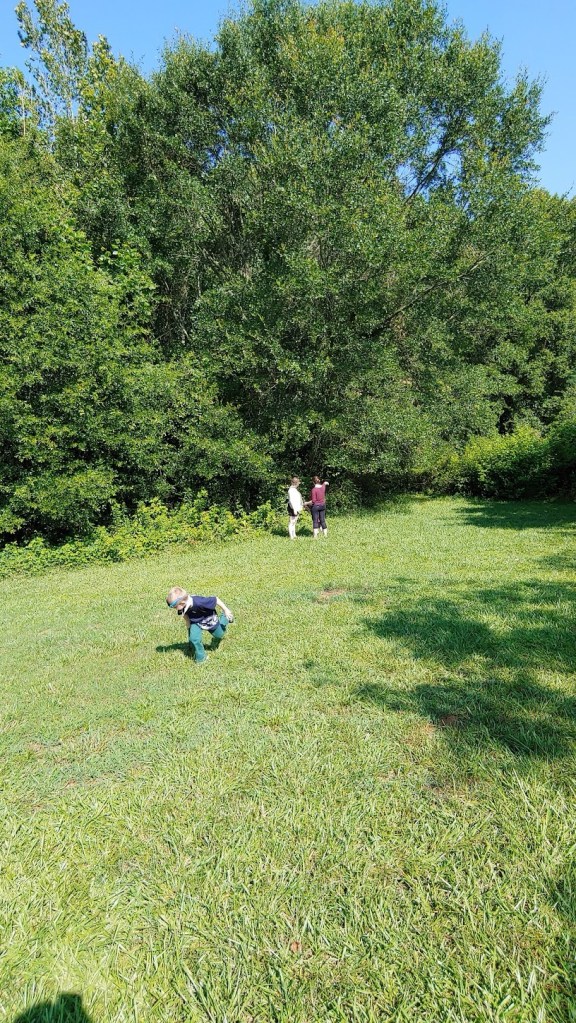
My son Elijah discovering one of the great joys of our childhood: picking blackberries in the woods behind our trailer

But for now, as I wrap up this chapter of my early years, I want to thank you for joining me on this nostalgic journey down memory lane. Each moment, whether spent in the woods behind our trailer or exploring the aisles of Toys R Us, has played a part in shaping who I am today.

In my next post, I’ll delve into the complexities of my church experience in South Carolina. From fundamentalist Baptist teachings to unexpected twists and turns, it’s a tale that’s as intriguing as it is enlightening.

Until then, be blessed, and stay tuned for more tales from my past.

Caffeinated Chronicles: Part 1 – From Goat Encounters to Sunday Sermons: My Wild Theological Journey Begins!

This is the first post in sharing about my life and theological journey. Believe me when I say it’s wild ride. I’ll plan on posting a series about the different places I lived and church and life experiences I had.

I’ve known about Jesus since I was born. Seriously. I’m not even joking.

Ok, perhaps I’m exaggerating a small amount. But only a little.

I was born in the Year of Our Lord 1989. March 21, 1989, in fact. My 35th birthday is just a few days from now. This time of year always causes me to stop and reflect. Reflection and introspection are going to be a common theme throughout this blog. It’s just kind of what I do. And it drives my wife crazy sometimes.

Now, where were we? Oh, yes. March 21, 1989. I am the second child of three, which means I’m also the middle child. My older brother is almost exactly two years older than I am, having been born in March of 1987. Don’t tell him I wrote about him, please.

The Virginia state welcome sign in 2020

I was born in a place called Clifton Forge, in the US state of Virginia. I have no memories of this place, but I have been through town a few times in later life. It’s a cute town, and that’s about all I can say about it. You see, I spent quite a bit of time moving when I was young. I lived in Virginia, North Carolina, and Kentucky. It’s in Kentucky that I have my earliest memories.

My dad went to college to be a school teacher, but he also went to seminary and was ordained as a pastor in the Baptist church. We moved to Kentucky when I was between 2 and 3 years old. My dad had accepted a job as a pastor at a small, independent Baptist church at the top of a mountain in a very rural area. I remember driving with my parents around the mountain roads, watching coal trucks zooming down the perilous curves, mere inches from a drop to their doom.

Our church in Kentucky. The church was the bottom level, and the top level was our home. Taken in 2020.

Many of my earliest memories also involve going to church. In fact, we lived in a small, two bedroom condominium that was positioned on top of the church itself. Every Sunday we would go downstairs to the church and go to a small side room for Sunday school and then into the main auditorium for the service itself, where my dad would lead the songs and preach.

I don’t remember a lot about the church. I remember that my mom taught Sunday school. I remember getting in trouble in church during the service and being dragged out by my mom, screaming, “No! No! I’ll be good! I promise!” I can still remember the feeling of her slapping my butt after we were a safe distance away. Now you understand why I was screaming.

It was also during this time that I remember hearing the message of (Independant, Fundamentalist Baptist) Christianity for the first time. When I say Baptist, people conjur up all kinds of images, many of which involve Southern Baptist churches or other more mainstream Evangelical churches. Trust me when I say that, while we shared similar theological views with these churches, we were far to the right of them. In fact, most people can’t even comprehend what I mean when I talk about it. It sounds like a cult. And that’s probably not a completely inaccurate description.

Basically, I was taught that everyone is a sinner. Adam and Eve (because we had an incredibly strict, literal interpretation of the Genesis story) ate the fruit in the Garden of Eden and thereby passed sin down throughout all humanity, where it spread like a sickness. As a result, God is angry.

Like super, super, inconsolably angry.

He (in this denomination, God is exclusively male) was angry at each of us even before we were born, because of this doctrine of Original Sin. As a result, we are all destined for eternal punishment in the undying fires of hell. You might think that this doctrine is a bit much to be teaching children, but it is at a young age that we begin hearing about this hellfire and God’s anger and sin.

Therefore, we are all in need of a savior. Thankfully, God gave us a way out and sent his son, Jesus to die for us and be resurrected. He was a perfect sacrifice because he never did any bad stuff. All we have to do is ask Jesus to save us and take away our sins and then we are saved and we go to heaven when we die instead of hell.

Sounds simple, right?

In theory, it is simple. But this doctrine of eternal torment in hell terrified me. And I don’t mean it just kind of scared me. It kept me awake some nights, worrying that I was going to die and go to hell. And so I did the natural thing. I asked Jesus to save me so I didn’t have to go to hell when I died.

But that didn’t end my fear. But that’s a story for another post.

Needless to say, church was an incredibly important part of my life during our time in Kentucky. Our lives were dominated by it. This domination continued throughout my childhood and adolescence and into my early adulthood.

My family at a friend’s graduation. I was probably 6 at this time.

But I still hold my time in Kentucky in a special place in my heart. It wasn’t all spankings and fear of hellfire. As it was a rural area, I was allowed to play outside on my own from a very young age. There was nowhere I could really go and get lost. I spent hours and hours in the church parking lot after a rain, pretending that I was a sailor and playing with a plastic boat in the streams of water that would be left rushing down the mountain.

My family in Kentucky. L to R: David, me, Marjorie, Rebecca, David Andrew

Our neighbors had goats, and they would often escape the fence and make their way into our church parking lot. They would do what goats often do, eat things and poop. I remember finding innumerable goat pellets left behind after they had attacked our parking lot. They looked like chocolate ball cereal. And yes, before you have to ask, I played with them. I did have the good sense not to eat them though, even though I often wondered if they actually tasted like chocolate cereal. I still have no idea.

It was also in Kentucky that my sister was born. I was five years old at the time. We had to drive several hours to Lexington, where my sister was born in a hospital. A favorite story my family liked to tell as I was growing up was that one of the nurses at the hospital told my dad that he had plenty of time before my sister would be born. He took my brother and me to Wendy’s to get some lunch.

The hospital where my sister was born, taken in 2020.

Upon our return to the hospital, a nurse chased us down, yelling at my dad, “Where were you?! While you were gone, your wife gave birth to your daughter!” My mom never, ever let my dad forget that one.

But overall, my memories of our time in Kentucky are positive ones. It was a beautiful place, with kind people. It was also a beautiful introduction to what it means to be human, and my first experiences of being independent, playing in our mountainside parking lot.

Anyway, I’ll plan to continue this history of my life and the development of my theology in my next post. Next up: moving to South Carolina, and my earliest memories of feeling inadequate both at church and in my life. It’s a wild trip.

As I reflect on the wild ride of my early years and the beginning of my theological journey, I’m reminded of the power of storytelling and shared experiences. I hope that my tales of goat encounters, Sunday sermons, and childhood fears have resonated with you in some way. But this is just the beginning of our journey together. I invite you to join me as we continue to explore the twists and turns of life and faith. Share your thoughts, memories, and reflections in the comments below—I’d love to hear from you! And if you don’t want to miss out on the next installment of my story, be sure to subscribe to my blog for updates delivered straight to your inbox. Until next time, keep exploring, keep questioning, and keep seeking truth.

Don’t Have Sex

**This is a repost from my other website: givenscalais.org

Much of my life has been spent worrying about the things that Christian’s don’t do.

Seriously.

From my youngest days I remember hearing sermons about all the things we shouldn’t be doing if we wanted to prove that we’re saved (or something like that). They would often say something along the lines of, “Once you’re saved you can’t lose your salvation… But, if you do these certain things it should make you question whether you were ever saved in the first place.” And so I was told:

“Don’t play the lottery.”

“Don’t smoke.”

“Don’t drink alcohol.”

“Don’t hang out with those types of people (unless your purpose is to evangelize them).”

“Don’t play cards.”

“Don’t befriend Catholics.”

“Don’t play Pokémon (seriously. This caused tension at my church. I loved Pokémon).”

“Don’t listen to rock music.”

“Don’t say bad words.”

And then the biggest don’ts of all:

“Don’t have sex.”

“Don’t think sexual thoughts.”

And especially:

“Don’t ever, ever, ever, ever, even think about, ever, ever being gay.”

This is not a comprehensive list.

And so, you can see, I was often left feeling inadequate. I would do something I wasn’t supposed to do, and then I would feel incredibly guilty and like I must not really be saved because I kept making mistakes. After all, if I were really saved, they told me, I would be able to stop doing all these things by the Power of the Holy Spirit™. And yet the Power of the Holy Spirit™ didn’t seem to be helping me. So therefore, I must not be saved and must not be able to access the Power of the Holy Spirit™.

And so, I asked Jesus to save me again. And again. And again. And again.

And again.

I could go on for many pages about the things that I heard that caused me to question my salvation. But I won’t.

This has caused a significant amount of psychological trauma for me. I’m not going to pull and punches here. What I experienced was spiritual abuse. It was a manipulation tactic for getting me to behave a certain way that was in line with the way that our leaders wanted. They said it was clearly what the Bible teaches. But I’ve read the Bible.

Spoiler alert: it’s a lot less clear and obvious than I was led to believe.

In fact, it’s quite messy and contradictory. It took me years to recognize that openly. But now that I’ve acknowledged it, I’m strangely ok with not having all the answers that I was supposed to have.

So rather than pretending to have all the answers and relying on the Power of the Holy Spirit™ to follow all the rules, why don’t we focus on what really matters, what almost all Christians will agree is the central point of the Bible: the life of Jesus Christ?

Jesus had rules too. And his are just as hard to follow:

“Love God with all your heart and soul.”

“Love your neighbor as yourself.”

And that’s it. Those are the rules. Rather than listing a bunch of don’ts, Jesus’ rules are stated positively, telling us what we should do. What if we focused on what we need to do rather than making a list of rules of things that we shouldn’t do if we’re really Christian? What if, before we did something we asked ourselves, “Is this thing loving to God?” or “Is this thing loving to my neighbor?”? How would our lives and our faith and our hearts be different if we lived this way?

Would we love the poor (another command from the Bible)?

Would we welcome the immigrant (also a command from the Bible)?

Would we care for the earth (one of the first commands in the Bible)?

Yes. Yes, we would.

We readily admit that the Pharisees of Jesus’ day misrepresented the Law as a burden to be caried and a list of rules to follow.

And yet, we’ve replaced this burden with another burden of our own creation. Jesus specifically called out the Pharisees for this exact thing, and I believe this same thing applies to many teachers and preachers today, “Jesus replied: You teachers are also in for trouble! You load people down with heavy burdens, but you won’t lift a finger to help them carry the loads” (Luke 11:46, Contemporary English Version).

Jesus came to set us free from this burden, so that we can live a positive life, a life of doing, a life of loving God and loving our neighbor.

So let us live lives characterized by what we do instead of what we don’t do. Let our lives be a positive shining example of the love of God, a love that transcends everything, a love that will leave the 99 sheep in search of the 1 that is missing. That is the God I serve.