Failing the Commandments, Clinging to Mercy

Father,

You gave us two rules and we didn’t keep either of them. The story of humanity is the story of you telling us the same things over and over and of us failing to follow. For some reason we humans feel the need to create more rules for ourselves, to misinterpret the things you’ve said to us and create more burdens for ourselves and those around us.

From the beginning you told us what you want. It’s stated most clearly in Micah, “Act justly, love mercy, and walk humbly with your God.” You desire justice and mercy more than countless sacrifices or keeping of festivals and religious celebrations. And yet, we failed. We decided we’d rather look out for our own best interests and what we perceive as justice instead of doing the things you so clearly asked of us.

And then your Son came to live among us, offering us the clearest picture yet of what you want. He told us what your two rules are: “Love the Lord your God with all your heart and soul and love your neighbor as yourself.” The apostles and other writers of the New Testament stated these things over and over, ad nauseum. But we still got it wrong.

Rather than focus our attention on setting our whole hearts to the tasks you gave us, we looked for ways to make ourselves seem better than those around us. Rather than doing as the rich man in the Gospel of Luke said and “going to the highways and byways so that his house may be filled,” we’ve chosen to seclude ourselves into our own little sects, only allowing in those we deem worthy.

You gave us two rules, and we failed both of them.

And lest you think I’m pointing the finger at others, I am all too aware of my own failings. Too often I judge others for the things they do or say, failing to see them for what they truly are: people created by you and loved unconditionally beyond all comprehension. Too often I’ve let my own insecurities get in the way of loving my neighbor as myself, as you’ve commanded. 

I can’t think of even one time I’ve loved you will all my heart and soul as Jesus commanded. Forgive me for my shortsightedness, my selfishness, and my self-centeredness. 

I’d like to promise I’ll do better, but I know that would be a lie. Help me to see past myself and to refocus my life on the things that are truly important. For it is in you that I have my life, and it is in you that all things will one day be reconciled. 

I look forward to the day when the blind shall receive sight and the lame shall walk, when all the tears will be wiped from every eye and your creation will be made whole again.

Until that day, please forgive us for our sins of failing to live up to your greatest commandments, and have mercy on us, for we can do nothing without you.

And for me, help me to overcome my own failings so that I can love you and love others more completely, for that is where I know I’ll find my true joy.

Amen.

Shoots of Spring

I was a young idealist.

I thought the world could change,

That green shoots of spring would emerge

From the dark frosty ground.

If I could just say the right words

Then people would hear;

Their minds and hearts would open

To the suffering they now ignore.

The world could be better

If people came together,

Joined hands

Sang the sweet notes of unbroken song.

The wrongs would be right.

A round table with no head or place of honor,

Where all humanity could sit,

Equally and joyfully.

But now I am no longer young

The painful approach of middle age

Creeps up silently in my sleep

A shadow overhanging my bed.

Am I still an idealist?

Do I believe that wrongs will be made right?

That a round table with no head

Will one day join all humanity?

No

And yes

A smaller vision takes hold.

No longer do I see the green shoots

Spring from the frosty ground.

Darkness attempts to grasp my hand.

But I see the brightness

In the smile of the child

Who has run so far from home

That no one remembers his name.

But I remember.

His mother grasps his hand,

Cradles his soft hair on her shoulder.

Comforts his crying,

Wipes the tears from his eyes.

“Thank you,” She tells me.

“For being there when I needed you.”

“For caring about me and my son.”

“For the roof and the kitchen.”

And then I remember.

My idealism has not faded with age.

It just seems that it 

Might have become a little

Smaller. 

I wipe a tear from my own eye,

But it’s no longer a tear of pain.

Rather, it’s a tear of happiness.

I dry it before she notices.

I gaze on this humble scene,

And a shoot of spring

Breaks through the dark frosty ground

Of my own soul.

Against the Darkness: Living Out the Gospel in Troubled Times

Ok, I’ve got to say something. I can’t just leave it open to interpretation.

I try not to be overly political here, and I’ll try to continue to maintain my sense of grace when I discuss these things. However, this fight is real. It seems that the Powers of Darkness are winning, and I won’t just sit back and let it happen without contributing to the fight.

I’ve been hesitant to call myself a Christian over the past several years because of the way that Christians are behaving in the United States. When I see the anti-immigrant, anti-poor, anti-whatever-I’ve-been-told-to-be-afraid-of rhetoric of the Evangelical church in the USA, it makes me want to separate myself from it as much as possible. It seems to me that the leaders of many of these churches have never truly read the gospels. 

But now I want to reclaim the label. I am a Christian in its most essential form, the way it was originally used. It was used mockingly in the book of Acts, a slur against those who followed Christ. Its meaning is “little Christ.” If there’s one thing that I both aspire to and am completely unworthy of, it’s being a “little Christ.”

And so, amidst all of this turmoil, amidst the fear-mongering and hatred of the current administration in the USA, I will choose to be a “little Christ.” I want to be someone who goes against the mainstream, who is ridiculed and reviled for living a life that is different to the broader culture. I want to live my life as Jesus did. I believe what he said in Matthew chapter 5, ““Happy are you when people insult you and harass you and speak all kinds of bad and false things about you, all because of me. Be full of joy and be glad, because you have a great reward in heaven. In the same way, people harassed the prophets who came before you” (Common English Bible).

The truth is, the man who is now the President of the United States thrives on fear and chaos. He stokes fears of immigrants and refugees to increase his own power and authority. His narcissistic tendencies will cause unspeakable damage to communities across national and color lines. 

As much as I’d like to be on the team of “can’t we just agree to disagree?,” I simply can’t.

Please hear me when I say that I am not looking to lose friends or acquaintances over this, but I also can’t promise to meet you halfway. You see, I know and cherish many people from some of the populations that will be hurt by this administration. I currently live in France, it’s true, but let’s face it: US policy deeply affects policy in the rest of the world. The hurt starts in my home country, and then it spreads outward, across the whole world.

So no. I won’t be quiet, and I won’t pretend that I’m somewhere in the middle. My conscience is wholeheartedly against the fear-mongering, harmful policies and perspectives of the American Republican Party. 

What I just said might make you very angry, but I care too much about the harm that will befall those who do not swear unfaltering allegiance to the Trump administration for it to matter much to me. I cannot simply remain neutral.

Rather, I will reclaim my Christianity and proclaim loudly that there is another way to be a Christian. There is a way to live out the values of the gospel and the words of Jesus when he tells us to welcome the stranger and to love our neighbors as ourselves.

This is the kind of life I want to live and the example I want to set for my children. 

If you feel the weight of this moment and the urgency to live out the teachings of Christ in a broken world, I invite you to join me in reclaiming what it means to be a “little Christ.”

Start small but act boldly:

  • Love your neighbor actively: Look for ways to support immigrants, refugees, and those marginalized by current policies. Volunteer, donate, or simply listen to their stories.
  • Speak truth in love: Challenge fear-mongering and hatred wherever you encounter it—online, in conversations, or in your community—but always with grace and compassion.
  • Rediscover the gospel: Immerse yourself in the teachings of Jesus, particularly his call to welcome the stranger, care for the poor, and love unconditionally.

Let’s show the world a faith that heals rather than harms, a faith that welcomes instead of excludes. Together, we can live as true reflections of Christ’s love and grace.

What will your next step be?

Caffeinated Chronicles: Part 11 – From Fundamentalism to Fractured Faith: Seeking a Holistic Gospel

Hello, once again,

Introduction

It’s getting harder to write these posts because there are so many things I want to say that to include everything would be a never-ending quest. I want to hit the highlights of my theological development, but there are so many twists and turns in my own mind that it’s truly hard to put words to these things. I hope you’ll forgive me, but I’ll do my best.

I told you that after high school I chose to attend a fundamentalist Baptist college. That’s the truth. Why? Is the natural next question. It’s one for which I both do and don’t have a good answer.

Fear and Hellfire

One primary reason is that I wanted to attend a Christian school because I was worried what would happen if I didn’t. Another reason is that I was truly unsure what I wanted to do with my life. I signed up for a secondary English education degree, but I already knew that it wasn’t really what I wanted to do with the rest of my life. I was a bit aimless, looking for direction, looking for answers to the questions that were beginning to come up about my faith. So I chose a place where I thought the answers would be easy to find, a place where my faith wouldn’t be significantly challenged.

I was both right and wrong about that last point. You see, this experience did answer some of my questions, but it raised significantly more, nuanced questions. It also had a different effect than was probably intended. It kind of helped crystallise some of the criticisms I had of fundamentalist theology and push me further to the fringes. I wasn’t out quite yet, but it helped me get there.

2007 was a different time

The second reason was much more practical. I was scared. I’ve mentioned before that I had undiagnosed depression and anxiety at this time. I didn’t sleep well, and any time something raised questions or doubts about my faith, it caused me tremendous anxiety, because if one facet of my faith turned out to be untrue, then the whole thing must necessarily collapse. I realize now that this was a ridiculous thing to think, but herein lies one of my harshest criticisms of fundamentalism: we are taught that our theology is the correct theology, and that any other way of thinking is incorrect. We are never given any kind of alternate framework that encourages doubts or questioning. So, in reality, my whole theology would have collapsed if even one thing turned out to be untrue. But above all, I was scared of going to hell, for not having a “correct” theology.

Don’t worry; I’m better now.

Doctrine and Doubt

The theological education at my college was exactly what you’d expect. Mostly it was laying out fundamentalist Baptist doctrines and giving Bible verses as support for these doctrines. When looked at through this lens, it was obvious. We were correct, and every other theological system was wrong.

This did have an affect on me. I was drawn in for a time. I would even have called myself a Calvinist, as a result of the teaching there. I’m sorry if that doesn’t mean anything to you; I’ll explain in a later post. I came to believe that the Bible must be inerrant.

But at the same time, I knew something was missing.

You see, when you read the Bible, you constantly see verses about God’s care for the poor and the outcast. You constantly see a longing for justice and peace. I was already a pacifist at this moment, because I didn’t think you could take the teachings of Jesus seriously and come to any other conclusion.

A Gospel of Two Halves

But when the professors were asked about outreach to the homeless and the poor, the response was always the same: “We don’t really do that, because any time we give aid there has to be some kind of gospel presentation.” In their eyes, people’s immortal souls were more important than any needs that they have in the present time. But I was beginning to have questions about this. I began to think of the gospel as two halves of a whole. One half of the gospel really did have to do with one’s spiritual well-being. At the time, I would have called it salvation.

But there’s a whole other side to the gospel that is (in my opinion intentionally) overlooked because of our emphasis on saving souls. If your faith doesn’t make a difference in this world, in this life, then how can you possibly hope to give people a hope in the next one?

Jesus said, “The Spirit of the Lord is upon me,
    because the Lord has anointed me.
He has sent me to preach good news to the poor,
    to proclaim release to the prisoners
    and recovery of sight to the blind,
    to liberate the oppressed,

And to proclaim the year of the Lord’s favor.

Through my time in fundamentalism, I heard countless sermons and lectures where these verses and others like them are spiritualised, construed to be talking about those who are poor in spirit or spiritually oppressed. Let me be clear: I absolutely believe in spiritual warfare and the fact that people can be spiritually oppressed and spiritually poor.

A different time indeed

However, I don’t think this is the primary meaning of these verses, especially when taken in whole context of the Bible. The truth is, the Israelite’s mistreatment of the poor and widows is a constant reason given by the prophets for the coming judgment of their nation. In my way of thinking, spiritual poverty and physical poverty often go hand-in-hand. People are neither completely physical or completely spiritual. Just like how I think of the gospel, I think that both sides of human nature are equally important to God.

And so I went searching.

Anabaptists Attraction

I began looking for other Christians with whom I could agree, who really took seriously both the spiritual and physical needs of creation. As I searched I noticed that most churches tended to either one direction or the other: either they emphasized and focused on meeting people’s physical needs, leaving the spiritual as an afterthought, or they emphasized meeting people’s spiritual needs, oftentimes neglecting the physical entirely.

And then I discovered the Anabaptists.

This is not going to be a long historical lesson about Anabaptism or its theology. Simply put, what I found among the Anabaptists was something that I had been looking for for a long time. In the Anabaptists was a group of people who took seriously both people’s personal relationship with God and the words of Jesus, when he said to love your enemies and love your neighbor as yourself.

I promised myself that I would find an Anabaptists church one day. But first, I needed to finish college. There were a lot of steps between learning about the Anabaptists and finally finding myself in an Anabaptist church.

But that’s a story for another time.

When Self-Doubt Meets Faith: Overcoming the Imposter Syndrome

“My mom wanted to tell you that she wants to become a Christian. She’s been thinking about it for a long time, but after getting to know you, she decided that it’s the right thing for her.”

“I think you bring a lot of strength to this house!”

“Christians are good people.”

“Just keep doing what you’re doing.”

“You’re the good kind of Mennonites.”

“God wants you here.”

All of these quotes are things that have been said either to me or to both me and Rachel during our time working at the Maria Skobtsova House (MSH) in Calais. Every time someone says something like this to me, I’m both flattered and intimidated. 

I’m flattered because my abilities to pretend that I know what I’m doing are obviously working.

I’m intimidated because I know that deep down none of those statements are true.

I know what you’re going to say: “Not so fast! You are a good person, and you really do impact people’s lives for good!” I’ve heard this before, many times in fact. Most often, it’s my wife who says this when I express to her my deepest insecurities and the fact that I feel like I’m faking everything. Even coming from the person I love and trust most, the words ring hollow to me. 

It’s not that I don’t believe I’ve done good work in Calais. I know I have. I know I’ve made a difference in the lives of the women that we serve here in MSH. 

But I can’t shake the feeling that one day I’ll be found out. One day I’ll be seen for what I really am: a complete failure, who just so happens to be good at pretending (I was an actor in high school, after all). One day my wife and kids will leave me, I’ll be kicked out of my job, and I’ll be on the streets, where I belong.

I understand that all of this might sound overly dramatic. And I know that it is. It’s just a feeling I get deep down that I will never be able to do enough. If people knew the truth about me, they wouldn’t want me around. The truth is I’m lazy, I have a sarcastic sense of humor that can really hurt people when I want it to, and I talk way too much. Sometimes I struggle with understanding why God allows the things to happen that we see in Calais. When I see how other Christians react, I wonder why I’m still a believer.

But I keep doing what I do here, trying hard to understand what the next right thing is. I feel like I fail more often than I get it right. Eventually people will see who I really am and everyone will leave me. I’m a faker, and until now I’ve been pretty good at it, but it can’t last forever.

After all, Scripture tells us that people are created in the image of God. If we truly believe this, then why don’t we focus on finding that image and seeking out the beauty in where God is already working in each person’s life. Is it really that much better to tell people that they are evil from birth to the grave, assuming that each person’s only intent is to do evil all the time?

I’m not just saying this to try to make myself feel better. I wasted so much time feeling worthless that I just can’t get it out of my head now. I’m doing much better these days, but the trauma of my childhood will always be with me. When you’ve spent so much time being told how much of a worthless, evil, inherently bad person, eventually you internalise it.

Perhaps the darkness inside each of us doesn’t have to be so dark at all. Perhaps there’s light in everyone, if we know where to look. Sure, we all do bad things. Sure, we break each other’s hearts. Sure we hurt and murder and kill each other. But we aren’t beyond hope. God is present in each of us, and we all reflect God’s light to a larger or lesser degree. 

But I don’t think I’ll ever shake the feeling of being a fraud, a failure, an imposter. I’m just waiting for the day to come when everyone will realise it.

But now, with all these kind words that have been shared with me, I feel like the burden has become mine. I have to continue living my life in a way that I can feel worthy of the things people say about me. If it’s because of me that people have chosen to become Christians, then it’s up to me to live my life worthy of the image of God that people see in me. What they think about me isn’t true, but I feel that it’s necessary to continue to carry on the facade of being the loving, caring person that people think I am.

Underneath it all I’m a hermit who just wants to crawl into my hole and give up.

But I can’t give up. The things people believe about me may not be true, but my intense belief that everyone is worthy of love is very real. And so I live with this contradiction within myself. I have to pretend to be one person, while on the inside I know that I’m not really that man.

Perhaps you feel the same. I’ve heard it referred to as “Imposter Syndrome.” But for me it’s not a syndrome; it’s the truth. 

But it’s something I’m working on. I’m trying to live my life in such a way that I don’t feel like an imposter forever. I want to live life so that at the end of the road I can look back on what I’ve done and say, “You really did make a difference.”

I don’t think the feelings will ever go away, all I know is that I can live a life dedicated to the image of God that I want to see in each person with whom I interact. Then, even if I feel like a fraud, I can have a true and lasting impact on those people that God loves. 

Which is everyone.

And though I know that many of my readers—and many who grew up in the same strict environment as I did—feel the same way, I believe you, too, can overcome these feelings of self-doubt and inherent worthlessness. Is this something you’re working on as well? Have you thought about it? How do you reconcile these contradictory ideas while still trying to love your neighbor?

Reclaiming the Sabbath: Finding Rest and Renewal

Sabbath.

Sabbath is a word that wasn’t used much in my faith tradition as I was growing up. I always thought of sabbath as something that Jews do. I knew that Jesus talked about it, but since Jesus came to fulfil the law, the requirements surrounding sabbath no longer apply to the church. At least, that was the perspective I received. Of course, in the tradition I grew up in self care is considered a waste of time and selfish. 

I’m reflecting on this today because my family is working on changing our schedule a bit to make our work among the refugee population in Calais more sustainable. We’ve decided for our second two-year term to make our weekends actual weekends. This means that we don’t generally work on Saturdays or Sundays. Of course, since we’re hardly ever at home during the week, we don’t have much time to do house work on weekdays, so we spend Saturdays doing the things we can’t do on other days. We use our Saturdays to do our grocery shopping, laundry, and house cleaning.

But then there’s Sunday. How we used to do things, we were too tired on Sundays to do much housework. As a result, our house was often strewn with laundry and toys. We’re working now on building a rhythm that allows some time for rest. We’ve decided to make Sundays our sabbath, at least as much as possible. Today we spent the morning before church preparing a meal and putting it in the oven. When we came home, our meal was ready, and we were able to have a delightful Sunday dinner together as a family. Later we’re going on a bike ride and watching a movie together.

This has me reflecting on deeper topics as well. The sabbath was always meant to be a special day of rest and reflection on the God that created us. Scripture commands as much, “Show respect for the Sabbath Day—it belongs to me” (Deuteronomy 5:12). The Sabbath is a theme throughout the Hebrew Scriptures, with constant reminders to respect the Sabbath and to keep it holy. Time for rest is clearly important to God.

But, just like any other commandment, fallible humans turned something that is meant for the good of humanity into a burden to be carried. This is a constant theme in the New Testament. There’s an occasion where Jesus and his disciples were walking through a wheat field, picking and eating the kernels from the wheat stalks. They were hungry, so they were doing what was natural. The religious leaders took issue with it, because the rules that had been written down over the centuries said that one cannot do any work or anything that seems like work on the Sabbath.

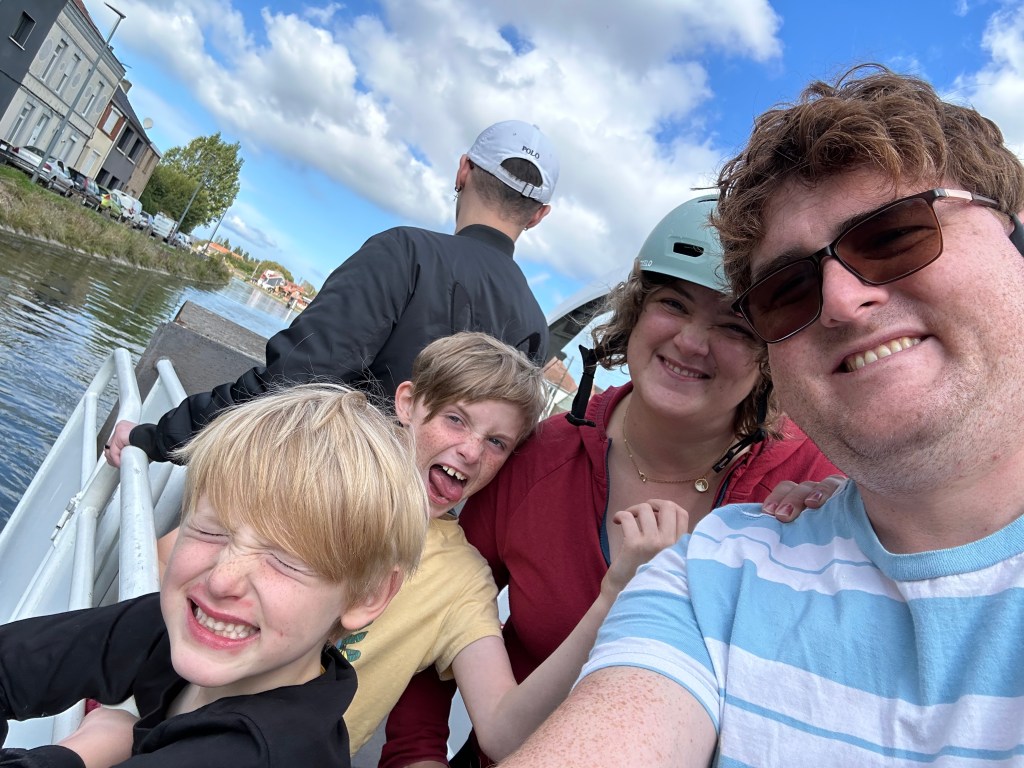
This Sabbath we went on a bike ride and then rode the free canal Bus of Calais

When they confronted Jesus and told him their problems with what he was doing, he pointed out there had been many exceptions to the rules that were made over the course of history, up to and including King David himself, who took holy bread from the temple on the Sabbath to feed his hungry troops. He ended his argument by stating, “People were not made for the good of the Sabbath. The Sabbath was made for the good of people” (Mark 2:27).

The point of this story is that God established the commandment to remember the Sabbath because he wanted his people to have a time to rest and worship the God that loved them. The Sabbath was always meant to be a time for people to rest, but the religious leaders ignored the spirit of this law and instead busied themselves with trying to work out exactly what “work” means. From this perspective, they created a list of rules about what does and what doesn’t count as work. This took the joyful rest and worshipful spirit out of the Sabbath and turned it into something difficult, a burden for the people for whom it had been meant as a restful day.

During the Christian Age, the concept of the Sabbath has largely been left behind, except by a few denominations. I wasn’t exposed to the concept until I was in my early 20s. During my volunteer program, we were given Fridays as our Sabbath days. On those days, we were free to rest in whatever way was helpful for us. I grew to cherish these days, since we worked hard the rest of the week and had many responsibilities. 

As I’ve grown and been married and had children, I have begun to recognise the importance of the concept of Sabbath. For my family, we are trying to make it a day of rest, worship, and togetherness, where we take a break from the stress of life and refocus our hearts and minds on the things that are truly important: our faith and our family. It’s a day that leaves me recharged and ready to take on whatever the week has for me, in my work among refugees in Calais. It’s a work that can often be difficult both emotionally and spiritually. I need these moments of Sabbath to remember who I serve and why I do what I do. It’s also a day to focus on my kids, the most important people in my life.

It’s a tragedy that this concept has been lost somewhere along the way. I think it’s time to reclaim the concept of the Sabbath, and to focus on taking care of ourselves so that we can continue to follow God’s greatest commandments: to love God with all our hearts and to love our neighbours as ourselves.

But instead of taking the tactic of the religious leaders in Jesus’ day, let’s not turn the concept of Sabbath into a burden, weighing people down with a list of rules that they must follow in order to properly observe the Sabbath. There are plenty of rules in our everyday life. God understood the difficulties of life, and so he made Sabbath for us, to give us a chance for rest, to remember the things that are truly important. Sabbath is truly holy, and God wants us to rest in this holy space.

Blessed Sabbath, my friends. May you find true rest in Jesus Christ our Lord.

Caffeinated Chronicles: Part 10 – From Teenage Rebellion to Refugee Crises: Embracing Complexity in Faith and Life

“Life was easier then, but I don’t want to go back.” 

Those are the words that ended my last post in this series, months ago. A lot has happened in that time. I’ve been to North America and back. I’ve visited a number of Mennonite Churches where I experienced true and heartfelt hospitality and welcome. I’ve shared the heartbreaks and hopes that we’ve experienced in Calais so far. And, finally, I came back to France, only to shortly afterwards receive news that there was a shipwreck on the English Channel in which at least 12 people perished, and very likely even more. Most of them were women and children. I’d gone from a joyful time of fellowship with families and loved ones to the lows of reality for people on the move here in Calais.

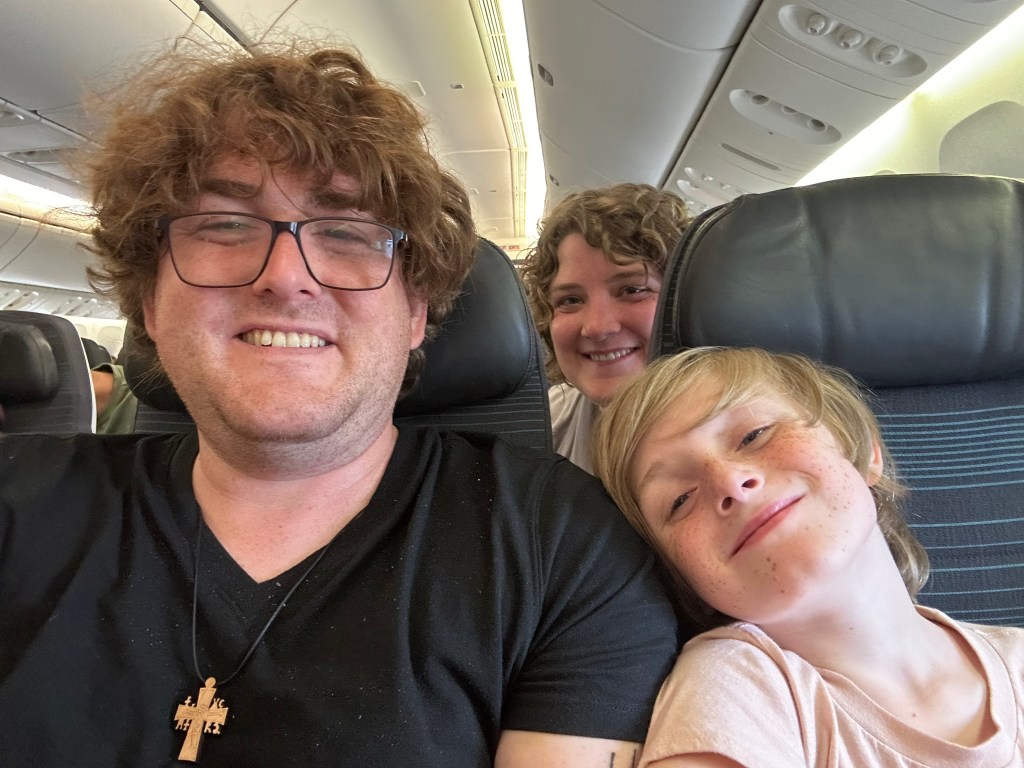
My family on the plane back to France

Perhaps that’s what I meant by the above quote. My life is incredibly complicated now, filled with so many emotions each day that I don’t know how my soul manages to contain them. I’ve experienced joy beyond measure, but for every joyful moment there’s a time when the waves of darkness sweep over me like those at the beach. This is because of the task I’ve set for myself, following the calling I believe I received from my commitment to Jesus. Life is difficult now, but I don’t want to live it in any other way.

While I’ve been considering this, I’m taken back to the moments when the seeds for what my life would become were planted. I realise that I briefly touched on my high school experiences with Shane Claiborne and the development of my theology in my last post. My family life was just as complicated though. It was around this time that my parents began to broaden their worldview somewhat. It was small at first, little things like being allowed to listen to contemporary Christian music like they played in chapel at my Lutheran high school or attending a Catholic mass with me for a school project. One thing that I’ve found to be almost universally true is that you can’t put yourself into new and different cultural contexts and still maintain the same level of prejudice that you had before. That’s one of the reasons my wife and I chose to bring our kids to France with us to work with the refugee population.

And I still struggled with some cognitive dissonance as well. Having been raised believing that only my church provided the path to salvation and the truth, I was trying to understand how these kids of other denominations could truly be Christians, as they appeared to be. That’s something that took many more years for me to work through.

Along with my parents’ broadening, my world opened up. I was now allowed to go to movies with my friends, sleep over at their houses, go to school dances, and the like. These are all things that had been denied me in the years prior. I took the opportunity to rebel in some ways, though I had the problem of always being perceived as the “good kid,” so much of my rebellion fell on deaf ears. What seemed significant to me then is quite laughable to me now. For example, I would sometimes go to parties with my friends and drink alcohol when I was 16 or 17.

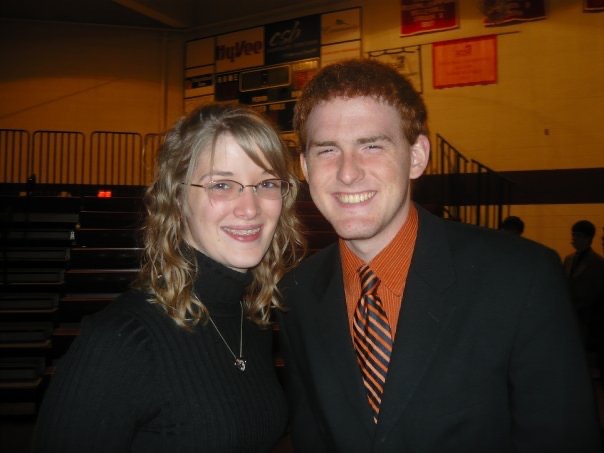
One of my prom pictures!

What you can see here is something not too different from what would be considered a “normal” teenage experience by most measures. I would drink with my friends on Saturday night, then I would go to church on Sunday and secretly judge everyone else for being hypocrites. I know, I know. My logic was flawed, but I was experience teenage angst and undiagnosed depression at the time, so I’ve learned to be easy on myself. 

The rest of my high school time was relatively uneventful. I thrived at my new school, even though I was a little lazy and didn’t always do the best I could. I broke a couple of hearts and had mine broken pretty significantly when I was a senior. I’ll never forgive myself for the immature and unkind way I treated that girl at my senior prom. She had every right to break my heart. I know she’s happy now, so I’m glad to see that.

Overall I cherish my high school memories. It was the time when I started to become the person that I am today, and I thank God often for the people that he put in my life to guide me. My only regret is that rather than continue on that trajectory I chose to attend a fundamentalist Baptist college. It was a mistake, but I met the love of my life there, so I guess it could have been worse.

What about you? Do you have memories that you cherish from your high school days? Do you ever wish you could go back? 

Reevaluating Biblical Inerrancy: A Personal Journey

*Warning: this will make some readers uncomfortable. However, it is important to engage thoughtfully and respectfully with perspectives that differ from your own.

Introduction

Hi, friends.

I know, I know. I’ve been absent for a while. We’ve been packing and preparing for our trip back to the United States. We’re spending time with our families, and then we’ll be touring the country visiting churches and sharing our work in France. As a result, I’ve been extremely busy.

Personal Faith Journey

This won’t be a follow up to my series about my own faith journey, but it will touch on a topic that is tightly interwoven with it. I want to share something that has deeply affected me and, I believe, hundreds of other people who have deconstructed their faith.

Since we’re in America at the moment, we took some time to visit some old friends of ours, people that we have known for many years and love dearly. I know that the wife has gone through an incredibly traumatic deconstruction journey, but I didn’t know that her husband ended up traveling the same path. While we were visiting with them, he told me that he is no longer a Christian. When he shared what caused him to lose his faith, I understood. I had similar questions myself.

The Problem with Biblical Inerrancy

You see, he was told his whole life that the Bible is inerrant, that there cannot be any contradictions or falsehoods, that the Bible is the literal Word of God spoken to humans. In this view, the Holy Spirit moved the hands of people who wrote the Bible to record exactly what he wanted. God is all-knowing; therefore, the Bible cannot be wrong.

Imagine my friend’s surprise when he discovered a contradiction in the Bible. He was unable to reconcile this contradiction, and so this began to lead him down a path of deconstruction.

Unfortunately, this is an incredibly common problem that young people face. This is especially true for people who grew up in a tradition similar to ours, where the Bible is held up as almost a fourth member of the trinity. In fact, many doctrinal statements begin with the Bible, instead of talking about God or Jesus first.

Contradictions and Deconstruction

Our whole early lives are spent in an environment where we attend church several times a week, and most of us are homeschooled or attend schools that are affiliated with our denominations. And so we spend much of our lives having the idea that the Bible must be the inerrant word of God. This is a fact that cannot be questioned. We often hear that if science disagrees with the Bible, then the Bible is right. Anytime there are any perceived contradictions in the text, they can’t really be contradictions; it’s simply a problem of our own understanding.

The Impact on Youth

As a result, when young people grow up, graduate high school, and move on to become adults, they are encouraged to attend colleges or universities that are closely connected with the denominations. The fear is that, if a young person attends a secular institution, the institution will corrupt him or her.

The thing is, they’re not wrong.

Isolation is a key signifier of a cult. And isolation is an important part of fundamentalism. Think about it: they control all information, treat outsiders as scary, corrupting influences, and claim to have absolute truth. I won’t mince my words–Christian fundamentalism is a cult. Each sect believes that they have the truth and that all other sects aren’t truly Christian.

When young (or old) people leave the cult and venture outside, they discover that the world isn’t as scary as they’ve been led to believe. Science may actually have something to contribute to society. And, devastatingly, the Bible does, in fact, contain contradictions that cannot simply be explained away.

When confronted with these things, the most common response is to leave, to walk away from the church and the faith. And I understand it. I had moments of crisis like this as a young adult. We spend so much time being indoctrinated to believe that this book contains all the answers to life’s problems and questions, and that it is the absolute truth and final authority, that when we are confronted with the fact that these beliefs are wrong, we can’t handle it. We’ve never been given any other framework with which to interpret the Bible. And since the Bible is the foundation upon which all other doctrines are built, the rest of our faith crumbles with the cracks in that foundation.

So we have no choice but to leave. If we can’t believe the Bible, what can we believe?

And therein lies one of the fundamental problems of fundamentalism. The framework of our faith collapses just like that.

I was one of the lucky ones, if you can call it that. My faith didn’t completely collapse as a result of my questions. I remember finding a seeming contradiction in the Bible and then running to apologetics websites to find an explanation. I remember sitting in church and reading the gospel accounts of the resurrection of Christ. They’re all very different. So I had to find a means of synthesizing these accounts. Many of my college years were spent this way.

A New Perspective on the Bible

The only thing that kept my faith from collapsing completely was my deep fear of going to hell. That’s another issue that I won’t get into right now. It may sound like I’m exaggerating, but I had undiagnosed depression and anxiety at the time, so I had a deep-seated fear of eternal punishment.

Here’s the problem–according to the Bible itself, the Word of God is Jesus. It’s stated as such in John chapter 1:

“In the beginning was the Word
    and the Word was with God
    and the Word was God.
The Word was with God in the beginning.”

And so the Word of God is a person, the one who was there at the beginning and who is revealed as the very expression of God on earth. Through Jesus we see who God is. And if something, even something in the Bible, doesn’t look like Jesus, then it very likely doesn’t look like God either.

And the Bible was written by people trying to understand what God was doing. As the theologian William Barclay says, “The Bible is the story of God acting and men interpreting, or failing to interpret, the action of God.

In fact, there are many, many problematic parts of the Bible, particularly in the Old Testament. God commands the murder of entire towns. God encourages the genocide of the Canaanite people. Slavery is assumed, and even encouraged at times. What we have in the Bible is people reacting to how God was working in their particular culture and society. Sometimes their interpretation is wrong. Yet, they always assume that God is on their side.

And then there are beautiful moments where the God that we recognize in Jesus breaks through. Consider one of my favorite passages from the book of Micah:

“With what should I approach the Lord
        and bow down before God on high?
Should I come before him with entirely burned offerings,
        with year-old calves?
Will the Lord be pleased with thousands of rams,
        with many torrents of oil?
Should I give my oldest child for my crime;
        the fruit of my body for the sin of my spirit?
He has told you, human one, what is good and
        what the Lord requires from you:
            to do justice, embrace faithful love, and walk humbly with your God.”

This passages drills down to the essential aspects of God’s character and his (or her) expectations of us who follow him (or her).

This is a short version of my new perspective of the Bible. There is much more to it than that, and it has taken me years of deconstruction to become comfortable talking about the Bible in this way. I know that some of my readers will be uncomfortable, even enraged, by what I have said here.

And that’s the problem.

The cult of Christian fundamentalism places too much emphasis on what the Bible exactly says. They claim to interpret the Bible literally, specifically when it comes to the Genesis creation story or verses about homosexuality. Yet their literalism fails to serve their own purposes when Jesus tells us to love our neighbor and to turn the other cheek. Suddenly they claim a spiritual individual interpretation. And so, like my own, their hermeneutic (way of understanding the Bible) is inherently inconsistent and contradictory. The difference is that I’m at least willing to admit that I can be inconsistent.

People will accuse me of having a low view of Scripture now. And perhaps I do, if I allow the phrase to be defined by Christian fundamentalists. What I do know, however, is that I will place everything in my theology below the center of my faith, Jesus Christ. Through Jesus I will interpret the Bible. Through Jesus I see who God is.

Perhaps if the church allowed young people to think of the Bible in this way churches wouldn’t be shrinking the way that they are now. Perhaps they wouldn’t need to send people to their own colleges and universities and isolate them from broader society.

Perhaps my friend would still be a Christian.

Encouraging Open Dialogue

If we look for Jesus in the Bible, suddenly things become gray instead of black-and-white. It’s scary at first, because it means that grasping final authority and absolutes is significantly more difficult. But maybe wrestling with these things is part of the purpose of the Bible, to encourage conversation among people who disagree to try to understand what God is like.

The point is that it’s ok not to have to have answers for everything. The great mystery is part of the allure of faith for me. It has allowed me to love and serve with Christians from a variety of different faith backgrounds, even people with whom I disagree profoundly. The truth is that we’re all on this journey together, the journey learning how to fulfill the greatest commandments as Jesus spoke them, “Love the Lord your God with all your heart, and love your neighbor as yourself.”

These two commandments are the central message of the Bible.

Conclusion and Call to Action

And now it’s your turn. How has your view of the Bible changed and developed as you’ve matured? What would you encourage Christian youth who are grappling with this issue to do?

Recommended resources:

Introducing the Bible by William Barclay

The Bible for normal people podcast by Pete Enns and Jared Byas

How the Bible Actually Works by Pete Enns

Caffeinated Chronicles: Part 9-Faith Journeys: Navigating the Gray Zones of Belief with Shane Claiborne and Upton Sinclair

Shane Claiborne, what can I say. In the story of my spiritual journey, there’s probably no single individual who has been more influential. And I discovered him thanks to a Lutheran teacher.

I’ve already talked about my cognitive dissonance at the discovery that Lutherans, whom I believed weren’t Christians, loved Jesus as much as any Baptist I’d known before. Sure, some of their teachings were different–In fact, one day we spent nearly the whole day debating infant baptism with every teacher in every class–but they lived lives that demonstrated the love of God.

But my religion teacher my final year of high school took the cognitive dissonance to a whole new level.

He looked like Jesus. Or, the Western, white version of Jesus that most American Christians picture. He had shoulder-length hair, a beard, and ear piercings. He played the drums during worship time in chapel. He venerated Mother Theresa, Greg Boyd, and, it turns out, Shane Claiborne. He was at once the embodiment of white Jesus and exactly the opposite of what my Baptist upbringing taught me a Christian should be.

In Dean Dunavan’s class I was quiet. I didn’t engage as much as others in my grade. I’m still this way when it comes to deep conversations. I need to think for a while before I feel prepared to respond, especially when I don’t feel 100% confident in my contribution. But I listened. He assigned us to read the book Irresistible Revolution by Shane Claiborne, a Christian activist and author who was incredibly influential in the lives of many young Christians of my generation.

Image Source

In his book, Shane Claiborne envisioned a new way of living out the Christian faith. A new way of life that asks questions like, “What if we took seriously the commands of Jesus when he says to love our enemies and to love our neighbors as ourselves?” He was strictly pacifist, and perhaps not communist, but at least communitarian in his way of thinking and living.

And I had an incredibly strong reaction against it.

I had been raised with answers, with a certain way of thinking about Christianity. Shane Claiborne questioned nearly every belief I held dear. It’s been years since I read the book, and I remember very few of the specific things he discussed in the book. What I do remember is the way he made me feel. It’s the book that planted a seed that has continued to grow throughout my life.

Shane Claiborne envisioned a world where Christians lived together in community, across theological lines, with a focus on changing the world serving our neighbors. He took to task the rich who tried to explain away verses where Jesus instructs the wealthy to give up their wealth. He wondered what the world would be like if we chose to love our enemies instead of going to war against them.

Those are just a few of the things I got out of reading the book. Again, I don’t remember a lot of the specifics, but I do remember how it made me feel. At first I was upset. But over time, as I thought more deeply about it, I came around to his point of view.

But there was a problem.

The problem is that I was still part of a fundamentalist Baptist church, and there was no room for this kind of thinking in those churches. And so, as things continued, I grew further and further from the church I had been brought up in.

And then there were the Lutherans. They were definitely more open than the Baptists, but they still very much fell into the white, suburban category. It didn’t help that it was a private Lutheran school, so the kids tended to come from upper middle class families.

And so I felt alone. Sure, there were people who were as engaged with what we were reading as I was. Sure, there were people who developed some revolutionary ideas. I think, however, that most of them lacked the experience of living in a poor family with parents who struggled to pay their bills every day. I still don’t know how my parents managed to enroll me at the school and keep my tuition paid. The thing is, when you’ve seen firsthand the cracks in the systems that are meant to support the lower systems of society, it has a way of radicalizing you. This is especially true of people who are exposed to ideas that present a dream of how things could be better.

I caught this dream. I caught it fervently. That same year I read The Jungle by Upton Sinclair, a radical socialist author, for one of my English classes. This story about working class families who were under the thumb of the Chicago meatpacking elite really spoke to me. I went on to read many of his other works.

Upton Sinclair Image Source

But I never lost my fundamentalist faith. Part of it was definitely the fear of going to hell that was instilled in me from a young age. But I think it went deeper than that. Reading Shane Claiborne and other authors like him showed a whole other side to the gospel. It was a gospel that didn’t only seek to save us from hell, but also to change our whole society into a place where no one would have to go without.

And I wanted to hold onto both of these sides of my faith. I still believed strongly in the gospel of faith and salvation, but I wanted to go deeper into seeking a more just society. I wanted to seek justice within the confines of the church in which I had been raised. And it made me feel isolated.

I felt like I was the only one. The only one who wanted to hold onto both sides of the gospel. The only one who was unwilling to compromise my beliefs in search of justice for all. When I looked into the world, I saw only churches who chose one or the other: Either they would hold onto the gospel of salvation in Jesus Christ and ignore the biblical call to seek justice for the poor and oppressed, or they would hold onto the gospel of social justice and ignore the biblical call to share the good news of Jesus.

But I wanted both.

Searching for a community that both clung to the deep personal spirituality with which I was brought up and the social gospel which I had discovered led me on a long path. It turns out I wasn’t alone in my beliefs. But it took years for me to figure that out.

Life was so much easier before, when things were black or white, when evil and good were obvious, when I didn’t have to figure out the right and the wrong because my leaders would tell me what they were. But now, I began to see everything in shades of gray. The hard and fast barrier between black and white began to break down as soon as I discovered that Lutherans were just as much real Christians as the Baptists I had grown up with. And it continued to fall as I discovered a theology that was open and welcoming to everyone, fighting for justice in a world filled with injustice. Right and wrong were a lot less clear when I discovered that the Bible isn’t as clearly interpreted as I had been led to believe. In fact, there were whole messages in the Bible that I’d never even heard before.

And so I continued walking alone, feeling a crisis of faith. It wasn’t really a crisis in the sense that I was losing my faith. It was a crisis in the sense that there was a lot more to having faith than I had previously believed. And I had to discover for myself what that meant for me.

This journey, which began with the challenging ideas of Shane Claiborne, continues to shape my life today. Now, at 35, I find myself in France, working among refugees, embodying the very principles of love and justice that Claiborne inspired in me. This journey of faith and justice is ongoing, and I anticipate it will continue to evolve, shaping my life and work for years to come.

My family on the beach at Calais, France

The problem with writing these narrative posts is that I never know where to stop or how much to include. I could go on. And on. And on. But I’ll stop for now. The influences of Shane Claiborne, my religion teacher, and Upton Sinclair kicked off a process that has deeply and profoundly changed me. In fact, I still believe I’m changing. I’ll never be the same person who was so sure of my faith and my beliefs that I was as a young person. Life was easier then, but I don’t ever want to go back.

In fact, I’m just getting started.

Caffeinated Chronicles: Part 8-Questioning Faith: Navigating the Rapids of Cognitive Dissonance in Lutheran Waters

I have to apologize once more. I’ve let my blog lapse a bit, since I’ve been rather busy the last couple of weeks. I know I have an audience of thousands, just waiting with breath held for my next post.

Just kidding. I know I’m mostly talking to myself. That’s ok.

In my last post, I talked about a crucial moment, one that altered the course of my life forever. It didn’t seem like it at the time, but looking back I can see how that moment and the events that followed had a hand in setting me on a course, a path that I’m still traveling.

So in a way, I’m thankful that I got suspended. I don’t know where I’d be if things hadn’t come to a head in that way 20 years ago. But it certainly didn’t feel like a good thing at the time.

I won’t get bogged down in details, but my brother ended up getting expelled from our Baptist school the same year that I was suspended. That’s not my story to tell, but I’ll just say that my brother is a little… different. And, in an environment where conformity and obedience are expected unquestioningly, being different is a serious problem.

And so, following those events, my parents were completely disillusioned with the church and the school where we had been. They didn’t immediately leave, but as in my own story, their lives were never the same.

The first things my parents decided was that I couldn’t attend that school anymore. You have to understand, for us public school just wasn’t an option. There were too many things that could go wrong in a public school, too many temptations to do evil. So my parents searched around the Saint Paul area to find another school where I could complete my final two years of high school.

My brother, by the way, was close to graduation when he was expelled, so he had to go on to get his GED (a high school diploma equivalent).

So my parents went searching in the summer of 2005, and they presented me with two options: the local Catholic school or the local Lutheran school. Both of those schools were a bit intimidating to me, because in the worldview in which I was raised, Baptists are the only denomination with the truth, the only way to achieve salvation. All those other churches were full of people who weren’t truly Christians.

To me, the Catholic school was the scarier option. Catholics worshipped Mary and the Saints, after all, and they didn’t even believe that Jesus was resurrected from the dead! (I know now that neither of those things is true, but it’s what I was taught). As a result, with little hesitation, I chose the Lutheran school, fully expecting it to be filled with cultists who practiced infant baptism.

Between the time that finished my 10th grade year at the Baptist school and began the next year at the Lutheran school, we still attended the Baptist church that was connected to the school. It was a somewhat awkward experience, because almost everyone from the youth group also attended the school. No one ever said anything particularly offensive about it to me, which would have almost been better than what actually happened. No, instead there were snide remarks and occasional hints of heresy directed my way by both other kids in the youth group and the leaders of the church.

See!? Jesus is still on the cross. Catholics MUST NOT believe that Jesus rose from the dead! Image source

“Don’t let those Lutherans convert you!” was something whispered in my ear by the school secretary one Sunday after church.

“Joseph,” my friend said, “when you go to public school…”

“It’s not public school,” I replied. “It’s a Lutheran school.”

“Oh well, same thing,” he said. “When you go to the Lutheran school, just remember who you are and don’t get into any fights.”

There were many, many other such things said to me that summer. In fact, I began to take it to heart. I was already primed to believe that Lutheran’s weren’t real Christians, and so it was a small stretch to believe that they would tempt me to sin. I viewed it as almost going into the proverbial lions’ den.

How naive I was.

The lions’ den itself. Well, at least they don’t have Jesus on the cross. Image source.

And so I went. Into the lion’s den. Only, the lions weren’t lions; they were people, just like me. With all their flaws and dreams and desires. Together they were reaching out for something greater than themselves.

Just like I was.

Instead of devouring me whole, they welcomed me. Instead of “converting” me, they asked me to think for myself. Instead of rejecting the tenants of the Christian faith, they loved Jesus with their whole hearts. They were different than I was told that they’d be.

And I didn’t understand.

For a long time that first year, I had a bout of cognitive dissonance. How could these people who weren’t really Christians love Jesus so much? How could they have such differing beliefs than I did, when the Bible was so clear as to what it taught?

All of this sounds ridiculous now. It just shows how far I’ve come.

It turns out there was a reason the Baptists didn’t want me to leave the Baptist fold. Exactly what they were afraid of ended up happening to me. I began to accept people of other Christian traditions as brothers and sisters in faith. The control that my fundamentalist church had on my life began to slip. And I began to ask questions.

Many of the same questions I still ask to this day. And I still haven’t found all the answers.

“What kinds of questions?” you ask. Well, that will have to wait until next time, when I tell you the story of how I was introduced to a writer who would challenge many of the things I hold dear, someone who affected many young Christians of my generation.

Curse you, Shane Claiborne. My life was so much easier before I met you.