Inhabiting Immanuel

Christmas is almost here.

This time of year is my favorite. It’s not quite the same here in France as it was back in Minnesota in the USA. For one, there’s no snow. It doesn’t get so cold. Family’s not around. So Christmastime is a different experience than it used to be.

But it’s still worth thinking about and reflecting on what Christmas means.

The Bible tells us that the Christ child would be called Immanuel, translated as “God with us.”

Take a moment and think about that.

Now, my faith has grown in a different direction from how it was in my fundamentalist upbringing. I find myself focusing less on literal miracles and questions of sin and salvation than I used to. My faith is now expressed in the concrete here and now most of the time.

This comes with its own difficulties that are different than the ones that came from my fundamentalist, sin-focused background.

And so, as Christmas comes, I want to try to remind myself of this incredible truth:

God has come to live among us.

This is the thing we celebrate at Christmas. God came into humanity, taking the form of a child. This child was born in humble circumstances. He didn’t come as a king, like the Creator of the Universe deserved. Instead, he was born to an unwed migrant in a farmyard.

Perhaps this Christmas story reveals something about the things that God cares about. Maybe it tells us something about where to look for God in our daily lives.

I must confess, I often get so caught up in the struggles of each day that I forget to think whether God might already be present with me, where I am.

God came down to earth and lived a life of deprivation and hunger. His family became refugees to Egypt. He grew up and took up his family trade. His story mirrors the ones I’ve heard hundreds of times in my work here. He knows what it’s like to accept hospitality. He knows how it feels to be innocently accused of violence.

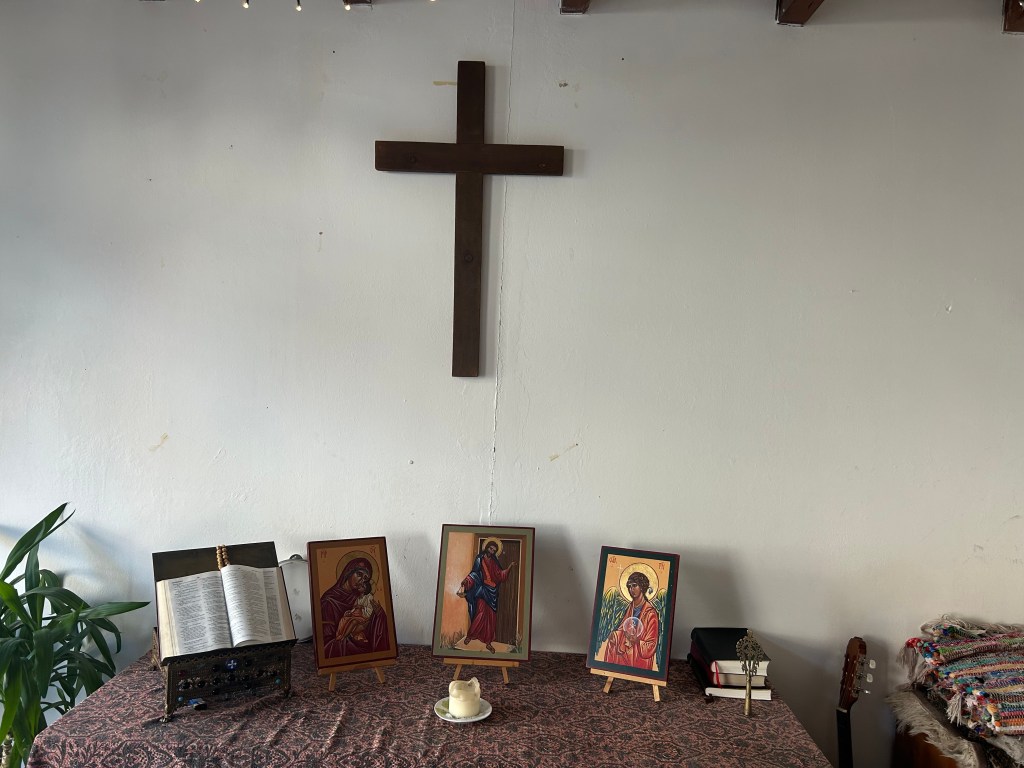
As Christmas approaches, let’s take some time to make central this miracle to our lives. Let’s search for the very real ways in which God With Us inhabits the people on the margins: The homeless, the poor, the refugee.

He knows their stories, for he has lived them.

What if we can learn what it means to know God With Us if we look for the places his story took him?

Learning to Reach Out Before I Break

Dear friends,

I think I made a mistake. Not a big, irreversible one, but a mistake nonetheless.

I made the mistake of oversharing. I caused people to worry unnecessarily, and for that, I am sorry.

See, the last couple weeks have been incredibly stressful. And when I get stressed, I write. I want the things I write to touch others so that they know that they’re not alone in their feelings or struggles. Anyone who looks like they have it all together is putting on a front, I promise.

And so, I wrote a couple of posts, one here and one at my mission website. I didn’t think so many people would read and respond to the things that I said.

I said I felt like giving up. And it’s true: For a time I did. And it’s also true that I felt alone and depressed.

But I forgot something. I’ve got many, many people around me who care about me and about my family. The outpouring of support and concern has been truly touching.

But please don’t worry about me.

Next time I feel like giving up, I’ll start by reaching out to people that care, people I can talk to and work through things with. I won’t start with a blog post that causes people to worry. That does a disservice to people I love.

I’m getting support and I’m doing ok. Now that I’ve had distance and time from that period, I realize just how supported I am.

I just forget sometimes.

I suppose this is just a long way of saying thank you. Thank you to all of you who have reached out and reminded me that I don’t need to struggle alone. Thank you to all the people who worried about me and took time to remind me that they care.

You may never realize just how much your compassion means. I promise it won’t be forgotten anytime soon.

How Crisis Makes Us Hurt Each Other

I hope that this means something. I hope it can help someone, and that it gives some perspective and light in a world that often seems overwhelmingly bleak.

I’ve been struggling lately. Not with depression exactly, but with the overwhelming sense of pain and suffering that I experience daily here on the border.

And I’ve noticed something.

Faced with the pain and the constant state of emergency and crisis, we sometimes don’t have a target for our grief and stress, and so we often turn our sights on each other. I do it. I’ve seen many other people here do it too.

Because the situation is always so stressful, and things keep getting worse, I sometimes find myself expressing my frustration and anger in unhelpful, and sometimes downright harmful, ways.

I turn against my wife, my children, my family, my friends, or anyone else who happens to be nearby.

After all, I feel safe with them. I feel like I can be myself. And sometimes myself is a real a-hole.

And I often say things that, while not exactly untrue, hurt those closest to me.

Especially my wife.

I recognize it’s not a healthy way to deal with stress. I realize that I have a responsibility to love those God has placed in my life first of all.

But it’s easy to forget.

What I’m trying to say is that there is a lot of unnecessary fighting and expression of anger that causes those of us who work in these situations to turn on each other, rather than uniting against those who are truly responsible for the ills of society.

For example, we’ve been dealing with one of the most stressful situations we’ve ever had to deal with in our work for the past week. In this situation, it seems that no matter what we do, someone vulnerable will end up being hurt.

Every choice is a wrong one.

And I feel powerless.

So I choose to take out my frustration and my anger and my desperation on the very ones who should be my safe place. Rachel and I spent much of the weekend and early part of this week arguing about our choices, arguing about what option hurts the least. Of course we didn’t really accomplish anything other than hurting each other.

I recognized this a couple days ago, and Rachel and I talked about it. We realized that we aren’t handling the frustration in a helpful way.

So yesterday we went for a lunch date. We turned off our phones and ate poke bowls with chopsticks at a local shopping center. We tried to talk about anything besides work and stress.

We weren’t completely successful, of course, but we went some way toward remembering the humanity in each other and that we are both on the same side. It’s the circumstances that are deserving of our anger.

Not each other.

I’d like to promise that I’ll do better next time, that I won’t let this happen again, and that my reaction will be healthier.

But I know it’s a lie.

But if I can do a little better, recognize what I’m doing before I hurt someone too badly, understand that my wife is there to support me, that she’s on my side, then maybe little by little, I’ll learn how to react to the intense situations in a healthier way.

And therapy helps too.

I’m mostly writing this for myself, but I want those reading it to understand that I see you. Sometimes life is just too much. Sometimes our struggles are too much to bear. Sometimes every choice is the wrong one.

But you aren’t alone, and you don’t have to fight alone.

Turn your anger and wrath on the systems that make these choices necessary, not on those by your side.

The situation is temporary, but the love and support of your community are lifelong. Lean on each other.

And I’ll try to be a better father and husband.

I hope you are able to take something from this, even if it’s understanding that everyone deals with difficult moments and everyone hurts the ones they love sometimes.

God bless you and grant you peace.

Light Shines in Darkness

Do you ever feel like there’s evil creeping up on you? Like a flood is going to rush for 40 days and 40 nights and take over your heart and mind?

Sometimes I do.

Most of the time I’m not really a believer. Sure, intellectually I assent to the things that I profess to believe. But that’s not what I mean. What I mean is, some days I can’t believe.

In fact, most days, if I’m honest.

But then, in spite of the creeping evil that seeks me out, trying to overwhelm me and turn me into something I’m not, I see a brief glimmer of hope. And that small hope sustains me even when I can’t believe.

Maybe that’s why I resonate so strongly with passages like John 1:5, “The light keeps shining in the dark, and darkness has never put it out.” (Contemporary English Version).

I struggle with depression. It’s just the truth. I never quite know how to describe it to someone without this problem. But darkness is the best analogy I can come up with. I think alternative country artist Bonnie “Prince” Billy captures it beautifully in his lyrics:

“But could you see its opposition
Comes rising up sometimes?
That its dreadful end-position
Comes blacking in my mind

[Chorus]
And that I see a darkness
And did you know how much I love you
Is a hope that somehow you
Can save me from this darkness?”

I love this song because it captures what it’s like to struggle with depression so beautifully. You can’t control it. Sometimes it just comes like a gray cloud on a sunny day, blacking out any golden rays that might reach you.

And when you get into a depressive spell, it can be hard to find motivation to do most things. You feel tired. You feel like no matter what you do it won’t be good enough. You feel like there’s no point in anything.

In the worst case scenario, you might feel like your life isn’t worth living and that your friends and family would be better off without you.

I’ve never felt the latter to a point that it would cause me to take any self-harming or life-threatening action, but I’d be lying if I said I’d never thought about it.

Why am I writing this? I’m not too sure. In fact, I don’t really feel depressed right now.

Maybe it’s a way of telling myself, when those dark, depressive times come, that there is a still a light that shines in the darkness, and that the darkness has not extinguished it.

No matter how dark the night, or how cloudy the day, the darkness can’t prevail.

Sometimes all it takes is one ray of sunshine.

And no, Rachel, Elijah, and Micaiah, it’s not ever your fault. Sometimes you are just the sunshine I need to break me out of my dark prison.

I love you.

Because of you, the darkness won’t overcome my inner light.

A quick note: If you are considering self-harm or suicide, please get help. No one needs to suffer alone.

In the USA: Call 988

In France: Call 3114

Caffeinated Chronicles Part 13: From Suitcase to Soulwork – Mission Year, Pictionary, and the Blues Musician from Memphis

Oof, it’s been a while. 

I believe my last post in this series had me talking about signing up for Mission Year. Wow, how am I going to cover that year in one post? Maybe I won’t. 

I applied for this program out of a deep desire to find like-minded people who wanted to live out the words of Jesus. I selected Atlanta as my first choice for a placement because I had grown up in South Carolina and wanted to reconnect with my Southern roots. 

Since Atlanta wasn’t a popular choice for people participating in the program, I was granted my first choice. 

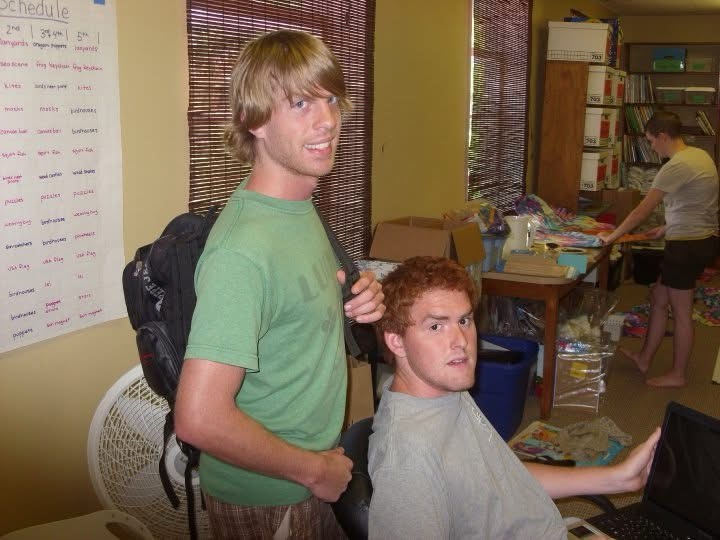
One day in the summer of 2009 I landed at the ATL airport, grabbed my suitcase, and walked out. I was met by a girl in a tie dye t-shirt. She was from California, of course. 

In the car, we drove to the Atlanta inner suburb of East Point, which, despite its name, is just southwest of Atlanta proper.  Once there, we pulled into a trailer park, and we were dropped off at a little White House at the top of a hill. 

The girl who’d picked me up at the airport, Kelly, I learned, was going to be my team-leader. She was a few years older than I, with dark hair in a ponytail. 

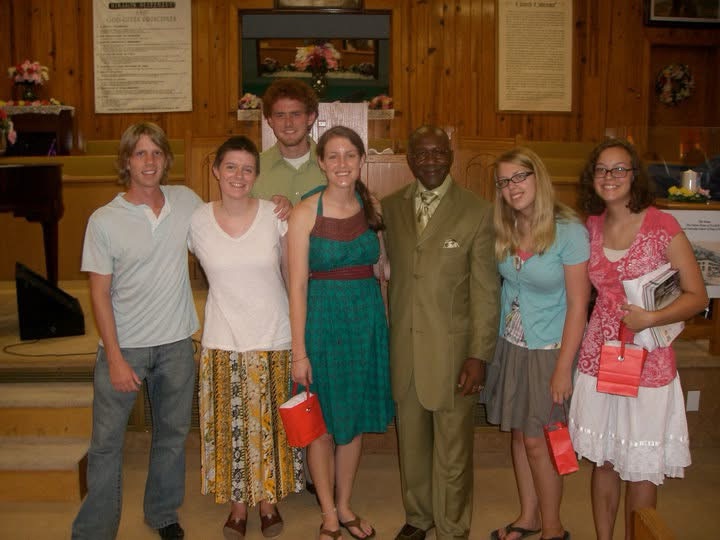
Next arrived the rest of my team, Chelsea, Kim, Rachael, and Andrew.  

My whole team with the pastor of the church we attended

At least I wasn’t the only boy. 

The house was a small two-bedroom. The girls would all sleep in one of the rooms, and Andrew and I would share the other.  

Andrew, my roommate, would come to be an important person in my life. He was short with long blond hair, and he was a blues musician from Memphis, Tennessee. An exceptionally talented drummer, he also played guitar and put my own guitar skills to shame. 

Oh well. 

Our first few days together, we didn’t really know what to do. We were placed on a strict technology fast, the house had no television, and we weren’t allowed yet to go out by ourselves. 

2010 was a different time, ok?!

So we played games. We played Uno, poker, bluffing games, and any other card game you could think of. But our favorite was called Pictionary-Down-the-Lane.  

It’s a simple game, and to play it all you need is stack of paper, equal in number to the number of players, and a pen for each person. Each person gets a stack of paper, and on the top one writes a word or phrase. Then everyone passes their whole stack to the left, and the next person is tasked with drawing what was written on the second piece of paper. Then the next person interprets what they think the drawing is, and so on, until the papers return to the original person. 

Each stack of paper is then flipped through and read aloud to the whole group. It’s like telephone with pictures. 

It’s simple; it’s stupid, but we had many hours of laughter and fun playing this game. It still holds a special place in my heart, but it doesn’t seem to resonate with other people the same way it does with me. 

I guess that’s the power of nostalgia.  

Me and Andrew. Where are you now, old friend?

To say we got along well would be true. Over the course of the year, we had our disagreements and conflicts, to be sure, but we managed to work through those things and finish out the year as a united team. 

The same can’t be said of the other Atlanta teams, however. But those aren’t my stories to tell. 

Throughout that year I spent my days with these people. They became a family to me in a sense, when my true family was far away. 

These were my first experiences as a young adult away from many of the difficult and stressful bonds of my fundamentalist upbringing, and so they are some of my fondest memories. 

There’s so much more to be said, but I’ll leave it for next time. 

Next time, I’ll fill you in on what our work was during that year. Don’t worry; grits and bacon feature heavily. 

Until then, blessings. 

Not About Hell: What Jesus Really Meant by the Narrow Path

“Go in through the narrow gate. The gate that leads to destruction is broad and the road wide, so many people enter through it. But the gate that leads to life is narrow and the road difficult, so few people find it.

(Matthew 7:13, 14, Common English Bible).

What does the above passage mean to you? Or rather, how have you heard it interpreted before? If you grew up in a church like the one that I did, I suspect I can guess. If you heard this preached on, the sermon probably said something along these lines:

“Jesus tells us that the world is headed to destruction because they are walking on the wide path toward hell. But we are on the narrow path, guarding our actions, repenting from sin, and eventually we’ll end up in heaven to spend an eternity with Jesus.”

In a nutshell, this is the kind of preaching I often heard as a young person. I’ve touched before on how scared I was of finding myself on the broad path that leads to destruction. I was terrified that any sin I committed meant that I wasn’t truly saved, that I would be going to hell when I died.

The problem is that I really don’t think that’s what Jesus is saying here.

To get at the heart of his teaching, we need to consider this passage in its proper context situating it within the broader teachings of Jesus. Don’t worry; I’ll try not to be overly academic here, since I’m far from a biblical scholar myself. I just think that we want to consider reading this passage in a different light from the one that is so often taught.

First, the context here is Jesus’ condemnation of the pharisees. This is the group of hypocritical teachers who loved to show off how holy they were and condemn other people for not following their teachings. They also made a whole lot of rules that people had to follow to be considered “holy.” If you’re anything like me, I bet that sounds familiar to you too.

In this passage, Jesus points out the hypocrisy of these religious teachers, saying things like, “When you pray, don’t be like hypocrites. They love to pray standing in the synagogues and on the street corners so that people will see them. I assure you, that’s the only reward they’ll get” (Matthew 6:5, CEB).

He goes on for a while like this before switching to tell his followers what a real life of righteousness looks like. (Also, that word “righteousness” has more than one meaning, which ties it to justice, but I’ll get to that in a different post). Jesus says things like, “Don’t judge, so that you won’t be judged” (Matthew 7:1).

Then he gets to the passage discussed at the beginning of this post. 

He tells us to enter the narrow gate and follow the difficult path to life. Now, is he talking about life after death here, what is commonly referred to as “salvation”? Maybe, but there’s more to it than that.

You see, given the prior context, where Jesus both condemns the pharisees and explains how to live a different life, he purposely follows it up with this statement. Jesus has been telling his followers this whole time what it looks like to follow the path to destruction and how to follow the difficult path to life. 

Jesus has spent the last several chapters of Matthew telling us how to enter the narrow gate that leads to life:

“How can you say to your brother or sister, ‘Let me take the splinter out of your eye,’ when there’s a log in your eye? You deceive yourself! First take the log out of your eye, and then you’ll see clearly to take the splinter out of your brother’s or sister’s eye.” 

“Ask, and you will receive. Search, and you will find. Knock, and the door will be opened to you.”

 “When you pray, don’t pour out a flood of empty words, as the Gentiles do. They think that by saying many words they’ll be heard. Don’t be like them, because your Father knows what you need before you ask.”

He ends by saying, “Everybody who hears these words of mine and puts them into practice is like a wise builder who built a house on bedrock” (Matthew 7:24). Therefore, finding the narrow gate and difficult path that leads to righteousness involves following the words of Jesus, something that our human nature struggles with.

And if that wasn’t clear enough, he gives us one rule, commonly known as the Golden Rule, “Therefore, you should treat people in the same way that you want people to treat you; this is the Law and the Prophets” (Matthew 7:12).” How do we follow the laws of Jesus and walk the path to righteousness? We treat others the way we want them to treat us. 

In the end, this will lead us to true, meaningful life.

My friends, I spent so many good years of my life worrying. Worrying about stepping off the narrow path and suddenly finding myself bound for hell. I wish I could go back and tell my younger self what I’m saying to you now:

“Don’t worry. Your job is not to worry about being perfect or doing exactly the right thing in every situation. Your job is to love God and love others, because, as Jesus says, ‘this is the Law and the Prophets.’”

This is indeed more difficult than it seems. We are selfish humans by nature, and we make mistakes. The point is not to be perfect, but the path is a journey, not a destination. Be merciful to yourself, learn from your mistakes. Ask God to help you love a little bit better every day. 

This thought can be very freeing. After all, Jesus also tells us, “Therefore, if the Son makes you free, you really will be free” (John 8:36, CEB).

Something beautiful happens when we choose to follow Jesus: We find true life. Later, in Matthew 11:28-30, Jesus tells us, “Come to me, all you who are struggling hard and carrying heavy loads, and I will give you rest.” 

So rather than a burden, with numerous rules to follow, Jesus offers us rest.

And that, my friends, is true life.

You Are Loved: The Central Message of Scripture

My friends,

There is one simple truth in Scripture that can change everything about our world. But we often fail to take it seriously.

Consider the words of John:

“This is love: it is not that we loved God but that he loved us and sent his Son as the sacrifice that deals with our sins” (1 John 4:10, Common English Bible (CEB)).

My friend, you are loved.

Take a moment to breathe deeply and concentrate on that thought. Say it to yourself, “I am loved.”

As you live in that moment, what do you feel? What do you understand? Does it affect your sense of self at all?

For me, this is an important reminder, because I spent so much of my life worrying about doing or saying the wrong thing and falling out of favor with God. I still struggle with this. For me, it’s easy to accept that God loves everyone else, but I have a hard time accepting that that same love applies to me.

I once heard a preacher say, “Yes, God loves you, but there’s still 99 per cent of the Bible left to preach.”

But he was wrong.

God’s love for humanity is the central theme of Scripture. God’s reconciling love is 99 per cent of the Bible.

Try with me to understand that each of us is loved more than we can even imagine. Each of us is cared for. 

As it also says in Scripture, “Aren’t two sparrows sold for a small coin? But not one of them will fall to the ground without your Father knowing about it already. Even the hairs of your head are all counted. Don’t be afraid. You are worth more than many sparrows” (Matthew 10:29-31, CEB).

Listen to me. You don’t have to be afraid.

My friend, you are loved.

If you only ever remember this one lesson, you have succeeded.

But don’t stop there. Let God’s love for you flow through you and outward into the world, so that you can remind others that they, too, are loved.

I’ll leave you with some more words from Scripture,

“The commandments, ‘Don’t commit adultery, don’t murder, don’t steal, don’t desire what others have,’ and any other commandments, are all summed up in one word: You must love your neighbor as yourself. Love doesn’t do anything wrong to a neighbor; therefore, love is what fulfills the Law” (Romans 13:9, 10, CEB).

Now take a moment and meditate on the God of love that lives in your heart, that cares for you more than the sparrows, that knows every hair on your head. Whether you are capable of accepting it or not (like me), you are deeply, inconceivably, wonderfully loved.

That is the God that I serve. That is the simple truth that can change the world.

Stop Striving: An Incomplete Interpretation of Psalm 46:10

What if we’ve misunderstood one of the most quoted verses in the Bible?

What I’m speaking of is Psalm 46:10. I learned this verse as a young person, and we always used the King James Version (KJV), so this is how I memorized it:

“Be still, and know that I am God: I will be exalted among the heathen, I will be exalted in the earth.”

An Incomplete Understanding

It’s not a bad translation, exactly. However, in my youth, the part where it says, “Be still and know” was always emphasized. It specifically meant that the Christian should make time and space to quiet their heart. They should sit in calm and silence with God to experience his presence. (Again, God was always male.) 

Not bad advice, right?

On the one hand, no, it’s not bad advice at all. In fact, I’ve often found myself reflecting on this passage in that sense. I feel that I am closest to God when I am by myself, specifically in nature. I think that’s true for many people. For me, sitting on a log in the middle of the forest is an ideal opportunity to spend time communing with the Most High. It’s a beautiful thing.

But the problem is, that’s not exactly what this passage is talking about. 

When reading Scripture, context is always important. If there’s one thing I’ve kept from my days in Bible college, that’s it. So if we read this verse in context we can get a better picture of what’s meant here:

“He maketh wars to cease unto the end of the earth; he breaketh the bow, and cutteth the spear in sunder; he burneth the chariot in the fire. Be still, and know that I am God: I will be exalted among the heathen, I will be exalted in the earth” (Psalm 46:9, 10, KJV).

While it’s pretty clear in the KJV version, I prefer other translations, like this one:

“God brings wars to an end all over the world. He breaks the arrows, shatters the spears, and burns the shields. Our God says, ‘Calm down, and learn that I am God! All nations on earth will honor me’” (Contemporary English Version (CEV)).

A More Complete Picture

While this is perhaps more of a paraphrase than a direct translation, I think it does a better job of capturing the intent of the passage. The text of Psalm 46:10 is directly related to the ending of war and strife. In this passage we have a God who ends wars and violence, destroying weapons and ending conflict.

I love the way the CEV translates it as, “Calm down, and learn that I am God!” I think this is the thing that we miss when we simply take it at face value. Other translations I’ve seen say “Stop fighting” or “Cease striving.” These let us know that God wants all conflict to cease and for everyone to turn to God and “learn that I am God.”

Since I’m a nerd and I don’t know Hebrew, I looked up an interlineal translation of this verse. I really like what it has to say about the “know that I am God” section. The Hebrew word meaning “know” here is transliterated as yada`, and the main meaning of the word is “to know (properly, to ascertain by seeing)” (source).

That idea of “to ascertain by seeing” is extremely important. So basically, what we’re getting from this passage is, “Stop your striving and pay attention so that you can see that I am God.”

There is a lot that we can take away from this, but I’ll leave it at two primary things.

First, the sense of the passage that I was brought up to understand isn’t necessarily wrong, but it is incomplete.

Second, God calls on us to end our conflicts with each other and to pay attention and learn that God is God. 

So What Now?

So what can we do about this? For one, we can recognize that our wars and conflicts with each other are virtually meaningless and not very important. God has called us to put down our weapons. 

This part seems easy for me, because I embraced pacifism when I became a Mennonite. But as I write this I wonder how many useless conflicts I’ve partaken in during my life, even nonviolent ones. This is a call for me to lay down my (metaphorical) weapons and look upward.

Second, we can “know” that God is God, or as the CEV translates it, “learn that I am God.” We can observe the ways that God is working in our world and acknowledge that God is over all things. 

We can open our hearts to the peace that comes with knowing that we are not alone and our lives are important to the One who created us. 

We are loved and beloved, but we so often stray from that love into meaningless conflicts and wars, whether personal or international.

Perhaps we can focus on learning that God is God when we quiet our hearts and our minds.

Maybe God can be found in places where we are less likely to look. Maybe God’s presence is found in a still, small voice, like the experience Elijah had on the mountain. All we need to do is stop fighting and listen.

We Already Know the Answer. We Just Choose not to Live It.

I’ve been sitting with a question from the Gospel of Luke lately, a question that has echoed across centuries: “Who is my neighbor?”

For context, this question comes from a moment when a lawyer was trying to trip up Jesus. This lawyer would have been extremely familiar with the most intimate details of the Jewish Law. The lawyer asks Jesus how one can gain eternal life. Jesus sees his trick and asks him, basically, “Well, you’re the expert! You tell me what the law says about this matter.”

Well of course the lawyer knows what Jesus wants him to say, so he responds as such, “You must love the Lord your God with all your heart, with all your being, with all your strength, and with all your mind, and love your neighbor as yourself” (Luke 10:27, Common English Bible).

And Jesus wholeheartedly agrees. After all, this is exactly what Jesus has been saying since the beginning of his ministry! But the lawyer just isn’t satisfied. He follows up with a question intended to trick Jesus into blasphemy:

“And who is my neighbor?”

Jesus proceeds to tell the extremely familiar parable of the Good Samaritan. If you’re not familiar, it’s the story of a Judaean man who is injured by thieves and left for dead on the side of the road. His own countrymen pass him by and leave him there to rot. But then another man passes by. This man is an enemy of the Judaean people, from a place called Samaria, where, Judaeans believed, they didn’t practice the true faith. This man puts the injured man on his donkey and takes him to an inn, where he calls a doctor and pays for the Judaean’s care.

In the end, the man who the Judaeans looked down on was the one who proved himself to be a true neighbor.

So, what does the parable of the Good Samaritan mean? What is the answer to the question, “Who is my neighbor?” The answer is: our neighbor is anyone. Even those we look on with disdain are our neighbor. Even those injured or ailing on the side of the road are our neighbor. 

A modern scenario where a Good Samaritan is needed

Over the 2,000 years since that moment, we keep asking.

We’ve continued asking the question, “Who is my neighbor?” It the same question we ask when we decide who is deserving of our compassion and who isn’t. It’s the question we ask when we determine who should have access to our resources, who should have clean water, who should have enough to eat, how much we can spare for those around us, both in our own countries and around the world.

Yes, my choice to write this post came out of what I’m seeing in world (particularly US) politics. The question doesn’t only impact politics though; it affects how we each choose to live our lives. 

The fact that we’re still trying to answer a question that was already sufficiently answered millennia ago isn’t bad. It’s just human nature to want to divide ourselves into tribes or communities. We always want there to be an in-group and an out-group. We want clear dividing lines as to who we can consider to be part of our culture and society and who can’t. 

I, myself, am equally guilty.

You see, my tendency is to be prejudiced toward those in power and those with money. To be glad when they fall and to reject their cries for help, to rejoice in their suffering. But Jesus tells me that the CEO of a corporation is just as much my neighbor as the homeless man on the street. This is a reminder that I need almost daily.

While I want to recognize my own prejudices, there’s a deeper truth here. The ones in power are the ones who are most responsible for asking the question. Those with wealth and influence have more responsibility to use those resources in the service of humankind. Jesus also said “Much will be demanded from everyone who has been given much, and from the one who has been entrusted with much, even more will be asked” (Luke 12:48b CEB).

We Westerners have been given much: freedom, democracy, wealth, resources, etc. And so it is our responsibility to treat those who do not have those resources as our neighbors. After all, the wealthy and religious leaders are the ones who crossed to the other side and passed by the injured man in Jesus’ parable. Do we want to be the ones who cross to the other side and pretend not to see, or do we want to be the good neighbor, like the one after whom this parable was named, “The Good Samaritan”?

I’ll close with one final thought, another parable from the Gospel of Luke, chapter 14: When a rich man throws a feast and none of his rich friends want to come, what does he do? Does he hoard his resources and refuse to share them?

No, not at all.

He instructs his servants, “‘Go quickly to the city’s streets, the busy ones and the side streets, and bring the poor, crippled, blind, and lame.’ The servant said, ‘Master, your instructions have been followed and there is still room.’ The master said to the servant, ‘Go to the highways and back alleys and urge people to come in so that my house will be filled” (Luke 14:21-23, CEB).

The question “Who is my neighbor?” has already been answered. We are all neighbors. The question that remains is much more pragmatic. Will we be like the religious elite of Jesus’ day, or will we take our example from the Good Samaritan and the rich man at the feast? Will we choose to share our resources with those in need, or will we keep them for ourselves?

The choice is ours to make. The consequences of our answer have ramifications around the world.

Caffeinated Chronicles: Part 12–From Holding Back to Leaning In: Faith, Pacifism, and the Girl with Curly Hair

Hello, my friends,

I’m sorry for the extended silence. It’s become harder to write these posts. As I get further into the story, there are more things I want to say, more details to share. Like all people, as I got older, my life became more complex, as has the story I want to tell.

So please forgive me if it takes longer between posts now.


Discovering Anabaptism

At the end of my last post, I talked about my discovery of Anabaptist theology. At that time, it was just an interest, not yet a deep understanding. I still had a long journey ahead before I left the Baptist church and found a tradition that aligned more closely with what I believed.

But before any of that could happen, there were a few things that needed to take place.


College Begins

Summer 2007. I had just completed high school and was stepping into the next chapter of my life: college.

She was there my first day.

I was immediately drawn to the girl with blonde, curly hair, glasses, and braces. She was cute in an innocent, authentic way. She hadn’t told me yet, but something about her told me she’d probably grown up on a farm.

Talking to girls had never been difficult for me, but expressing my real feelings? That was harder.

I don’t remember much about our first meeting, but I do remember movie night during our first week at school. We sat next to each other and talked through the entire film. At one point, she handed me her blue, flat phone and said I could put my number in it–if I wanted.

I didn’t know it then, but Rachel was going to become my life partner, the one who’d walk beside me through struggles with kindness and grace.

And there she was. With a creep looking over her shoulder.

A Relationship Without Touch

Our college didn’t allow dating for first-year students. So our early relationship was built on group hangouts, texting, shared meals, and chapel visits.

One day, I asked Rachel to take a walk with me down by a pond near our school.

“I have to be honest with you. I like you,” I said, as the autumn sun set behind the fountain.

“OK,” she replied.

It wasn’t quite what I expected. So I followed up:

“So… can I assume you like me too?”

“You could say that,” she said.

Again—not exactly what I was hoping for. But by then, I had learned that was as close to a “yes” as I was going to get.

No, we didn’t kiss. We didn’t even hold hands. Physical contact was strictly forbidden at our school—and we were good Baptist kids. In a way, that was a blessing. It let us build our relationship on emotional and spiritual connection. But as a young man, it wasn’t always easy.

I still don’t know what she saw in me.

Cracks in the Foundation

My next two years were what you’d expect for a Baptist college student: classes, church, papers, friends, and a girlfriend. I was immersed in Baptist theology, and instead of making me a stronger fundamentalist, it had the opposite effect.

I began to see what I felt were inconsistencies in the teachings.

I was already a confirmed pacifist by this point. Shane Claiborne and Greg Boyd had helped shape my convictions. I believed Jesus meant it when He said, “turn the other cheek” and “bless them that curse you.”

But it felt like the very people who insisted on taking Genesis literally were more than willing to spiritualize Jesus’ words in the Sermon on the Mount.

That contradiction bothered me. Deeply.


A Quiet Crisis

I found myself in a quiet crisis of faith.

As I mentioned in a previous post, I had asked Jesus to save me more times than I could count. But I struggled with doubts about Scripture, about doctrine, and about the answers I was being given. None of it felt satisfying.

By the middle of my second year in college, I was convinced I must be the only one feeling this way.

So I started searching.

I wanted to find others who took the words of Jesus seriously, who believed in both the kingdom and the cross, both love and sacrifice. That search led me to Mission Year.


Mission Year

Mission Year was a program that placed young adults in vulnerable communities to serve, not to proselytize, but to listen, learn, and love. The goal was to live among those we served, and to allow that experience to transform us. It came from a distinctly Christian perspective but without the usual trappings.

Their motto?
“Love God. Love people. Nothing else matters.”

That line drew me in.

And so, I applied.