I’ve been sitting with a question from the Gospel of Luke lately, a question that has echoed across centuries: “Who is my neighbor?”
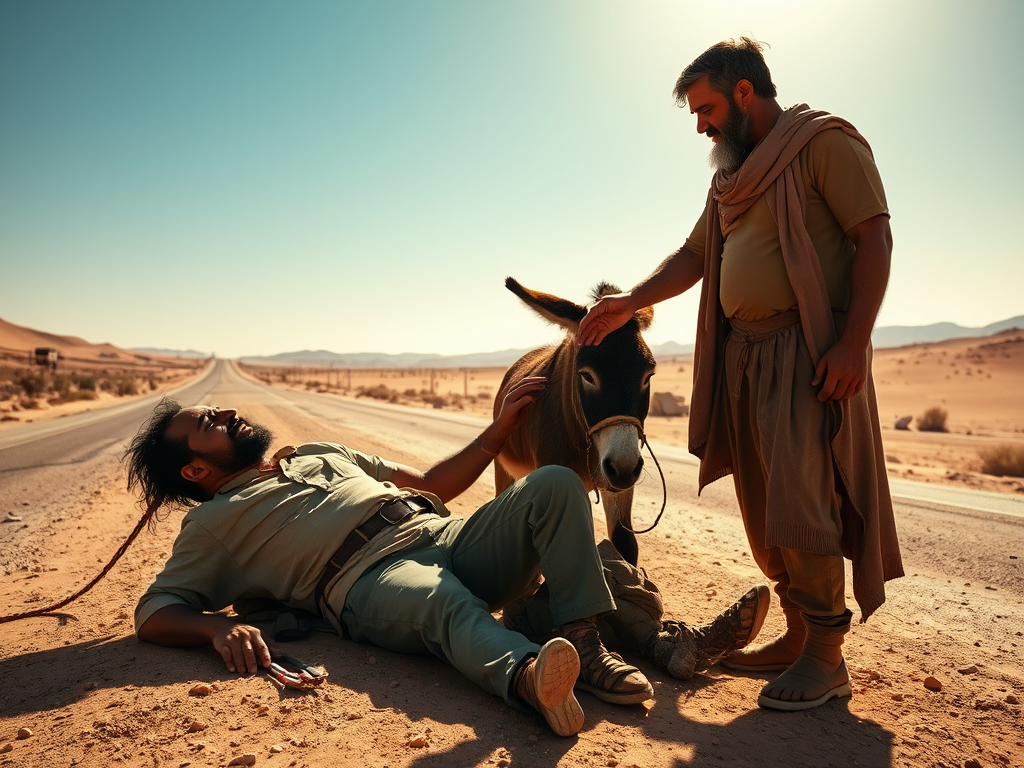
For context, this question comes from a moment when a lawyer was trying to trip up Jesus. This lawyer would have been extremely familiar with the most intimate details of the Jewish Law. The lawyer asks Jesus how one can gain eternal life. Jesus sees his trick and asks him, basically, “Well, you’re the expert! You tell me what the law says about this matter.”
Well of course the lawyer knows what Jesus wants him to say, so he responds as such, “You must love the Lord your God with all your heart, with all your being, with all your strength, and with all your mind, and love your neighbor as yourself” (Luke 10:27, Common English Bible).
And Jesus wholeheartedly agrees. After all, this is exactly what Jesus has been saying since the beginning of his ministry! But the lawyer just isn’t satisfied. He follows up with a question intended to trick Jesus into blasphemy:
“And who is my neighbor?”
Jesus proceeds to tell the extremely familiar parable of the Good Samaritan. If you’re not familiar, it’s the story of a Judaean man who is injured by thieves and left for dead on the side of the road. His own countrymen pass him by and leave him there to rot. But then another man passes by. This man is an enemy of the Judaean people, from a place called Samaria, where, Judaeans believed, they didn’t practice the true faith. This man puts the injured man on his donkey and takes him to an inn, where he calls a doctor and pays for the Judaean’s care.
In the end, the man who the Judaeans looked down on was the one who proved himself to be a true neighbor.
So, what does the parable of the Good Samaritan mean? What is the answer to the question, “Who is my neighbor?” The answer is: our neighbor is anyone. Even those we look on with disdain are our neighbor. Even those injured or ailing on the side of the road are our neighbor.

Over the 2,000 years since that moment, we keep asking.
We’ve continued asking the question, “Who is my neighbor?” It the same question we ask when we decide who is deserving of our compassion and who isn’t. It’s the question we ask when we determine who should have access to our resources, who should have clean water, who should have enough to eat, how much we can spare for those around us, both in our own countries and around the world.
Yes, my choice to write this post came out of what I’m seeing in world (particularly US) politics. The question doesn’t only impact politics though; it affects how we each choose to live our lives.
The fact that we’re still trying to answer a question that was already sufficiently answered millennia ago isn’t bad. It’s just human nature to want to divide ourselves into tribes or communities. We always want there to be an in-group and an out-group. We want clear dividing lines as to who we can consider to be part of our culture and society and who can’t.
I, myself, am equally guilty.
You see, my tendency is to be prejudiced toward those in power and those with money. To be glad when they fall and to reject their cries for help, to rejoice in their suffering. But Jesus tells me that the CEO of a corporation is just as much my neighbor as the homeless man on the street. This is a reminder that I need almost daily.
While I want to recognize my own prejudices, there’s a deeper truth here. The ones in power are the ones who are most responsible for asking the question. Those with wealth and influence have more responsibility to use those resources in the service of humankind. Jesus also said “Much will be demanded from everyone who has been given much, and from the one who has been entrusted with much, even more will be asked” (Luke 12:48b CEB).
We Westerners have been given much: freedom, democracy, wealth, resources, etc. And so it is our responsibility to treat those who do not have those resources as our neighbors. After all, the wealthy and religious leaders are the ones who crossed to the other side and passed by the injured man in Jesus’ parable. Do we want to be the ones who cross to the other side and pretend not to see, or do we want to be the good neighbor, like the one after whom this parable was named, “The Good Samaritan”?
I’ll close with one final thought, another parable from the Gospel of Luke, chapter 14: When a rich man throws a feast and none of his rich friends want to come, what does he do? Does he hoard his resources and refuse to share them?
No, not at all.
He instructs his servants, “‘Go quickly to the city’s streets, the busy ones and the side streets, and bring the poor, crippled, blind, and lame.’ The servant said, ‘Master, your instructions have been followed and there is still room.’ The master said to the servant, ‘Go to the highways and back alleys and urge people to come in so that my house will be filled” (Luke 14:21-23, CEB).
The question “Who is my neighbor?” has already been answered. We are all neighbors. The question that remains is much more pragmatic. Will we be like the religious elite of Jesus’ day, or will we take our example from the Good Samaritan and the rich man at the feast? Will we choose to share our resources with those in need, or will we keep them for ourselves?
The choice is ours to make. The consequences of our answer have ramifications around the world.
 Coffee & Theology